Wednesday, November 24, 2021

DEPRECATED BLOG IS DEPRECATED

Hi all, I've deprecated this blog and have stopped updating it. Eventually it will be deleted and taken offline.

Going forward, you should use https://www.bradmurgen.com if you're interested in my content.

Cheers!

Saturday, April 24, 2021

Dragonlance: Legends [3] Test of the Twins (1986)


Like Chronicles, things finally get exciting here in the last book of Legends.  The story comes together and we pull in all the elements and characters from Chronicles that made that trilogy good, but had been lacking so far.

It's like the authors finally realized all the cool, unique things about Dragonlance (that doesn't include kender) were missing, so they found a way to bring them all back in the last half of the book. We get the draconians again.  Tanis and Kitiara.  Flying citadels.  Dragons.  And Lord Soth!

Before you continue:

  • This is Part 6 of my Dragonlance Retrospective
  • See this blog post for an overview of the Retrospective
  • These blogs are not plot recaps—they are most effective in conjunction with your own re-read of the series
  • Warning: CONTAINS SPOILERS FOR BOTH SERIES


Let's Start It Again

I didn't really talk about how the previous book ended in my previous post.  It's a very similar scenario as the end of the first book.

Raistlin and Crysania were opening the portal at Zhaman just when Caramon and Tasslehoff were using the time traveling device to go back home—and Caramon and Tasslehoff end up too far in the future.  A future where Raistlin succeeded in destroying Takhisis and becoming a god.  A future where Krynn is dead and the last days are upon them.

Part 1 of this book was probably pretty effective back when this came out, but these days it's somewhat ho-hum.  Travel into the future, see how the world has been ruined by a few minor choices, go back and make sure it doesn't happen.  The best part about this section is the last part, where Astinus, Dalamar, and Elistan have gathered together at the end of the world.  Caramon and Tas meet up with them and get the last volume of the Chronicles of Astinus, which tells them what happens in the alternate timeline, so they can fix it.  Then Caramon and Tas go back in time to Part 3.

Let's Bring Them Back

Part 2 focuses on all our non-Majere favorites in the "present"... that is, if Tanis, Dalamar, Elistan, Kitiara, or Lord Soth are a favorite of yours.  It's an okay section and provides a nice change of pace from Caramon and Tas, who I don't feel are strong enough characters to carry an entire novel.  Raistlin is the star of the series but he's offscreen for most of this one, much like he was in Dragons of Spring Dawning.

We get a nice prelude that reveals all the details of Lord Soth's downfall, told by the death knight himself.  Really enjoyed that since he's one of the cooler characters.

In general, though, this part of the book simply sets the stage for Part 3, featuring the same battlegrounds from Chronicles, namely the High Clerist's Tower and Palanthus.  We get some dragon riding action, with Tanis on Fireflash, the bronze dragon Flint and Tas rode in Chronicles.  The conflicts this time around are collectively called the Blue Lady's War.  (I didn't know that until I did some research just now.)

Also, I'm not sure how the timing works on having Raistlin battle Takhisis just weeks after they all began this journey back in the first book, but I guess it works when you want to have Tanis and Kitiara back in the narrative.
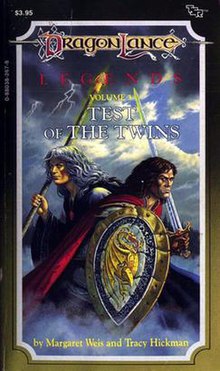
Let's Check the Cover

Courtesy of Wikimedia
The cover for Test of the Twins finally shows both Raistlin and Caramon, although it probably should just show Tasslehoff (see next section).  Same reliable Larry Elmore, but this time it's almost an action shot.  In terms of the original covers, I like this one the best out of the trilogy.

You can see the higher quality version on Larry Elmore's site.

In terms of the newer covers, the current one for this novel is way better.  It shows the final scene in the Abyss, in front of the portal, where Caramon is cradling a blind Crysania and Raistlin is about to be overwhelmed by Takhisis.  Of course, it appears that they are inside the Tower of High Sorcery where the portal is, rather than in the Abyss itself...but I'll let that slide since it's pretty cool.

Let's Do It Again

Part 3 features the final battle of the Blue Lady's War.

Finally, the draconians are back!  After basically two books of nothing—because they didn't exist in the past—we get to see them again.  Well, mainly we see them fighting again, dropping from dragons and flying citadels into the streets of Palanthus.  Which leads to the best part of the book...

...real action with a flying citadel!  After a tease at the end of Chronicles, this is very welcome.  If you remember in that trilogy, they just floated ominously above Palanthus.  Not so this time!

We not only learn how they are created (they rip castles out of the ground), we get to go up to one and fly it!  Well, Tasslehoff does, at least.  With a gully dwarf.  Sigh.  It's okay if you're not excited any more.  Come to think of it, we did this already, right?  In Chronicles, when we got to observe a dragon battle and had to do it from the point of view of Tasslehoff and Flint?  Another kender and dwarf.

And once again, Raistlin is the hero...he saves the world from certain destruction, though this time it's of his own making.  So is he really the hero?

He's not, in my opinion.  It's actually Tasslehoff, Krynn's Forrest Gump.  He controls the narrative, remember?  In the last section of the book, he bumbles his way through the battle of Palanthus, saves Tanis and Fireflash, saves Tanis and Caramon in the flying citadel, saves Dalamar, Crysania, and the world by flying the citadel to the Tower of Sorcery so Caramon could get in there and go into the Abyss to stop Raistlin from re-entering Krynn.  All hail Tasslehoff.

It gives me Lord of the Rings vibes the more I think of it.  What is it that Gandalf said?

“Even the smallest person can change the course of the future.”

Let's See

In the previous volumes of Legends, I ditched the interior illustration section I had done for Chronicles, because the illustrations seemed a bit lazy to me.  Well, this time they are mostly the same, except for the third part of the book, when Raistlin and Crysania are in the Abyss.  For those chapters, they used different sets of eyes to indicate who was narrating.

There's Raistlin's angry hourglass eyes, easily recognizable.  Then Takhisis's sultry eyes that don't look evil, only beautiful.  Then Crysania's teary, blind eyes.  And finally Raistlin's closed eyes when he realizes what he must do to save Krynn.

I didn't remember these images at all and appreciated how they were used to supplement the text.  By far the best use of chapter images in this series.


Let's Feel Bad?

Something I've always liked about the Dragonlance titles by Weis & Hickman was how they were a bit more "realistic" than other high fantasy at the time, in terms of consequences.  People die, people are drunks and have problems, people make bad decisions and pay for them dearly.

As such, Kitiara by far has the worst fate in the entire series.

Kitiara hitched herself to Raistlin's wagon and in the event of his victory, would have made out just fine.  Instead, Dalamar kills her and Lord Soth takes her soul, his to torment forever.  She is clearly fearful of this fate and even Tanis is disturbed by it, as he struggles to let go of the claim she had on his heart so that Soth could take her.  It is that action that seals Kit's fate and despite all the evil things she had done, I felt bad for her.

Raistlin, of course, sacrifices himself and remains in the Abyss to save the world.  However, it's not exactly clear what that means for his soul or what he'll have to endure, and I'm sure there's other material after this that expands on it (which I probably won't read).

Let's Reminisce

Here's a last bit of nostalgia for this retrospective.  When I was cleaning out my garage this past summer (like everyone else during the pandemic), in addition to the unpainted Villains miniatures and other forgotten treasures from my childhood, I rediscovered the D&D character sheets my friends (Josh, Jed, and JP) and I used during that year in Rhode Island, when I first read Dragonlance.

Sinder was my character.  My older brother actually came up with the name.  (Sinder and Vyrastas, which I use for gaming, were character names he used in the Might & Magic game on Commodore 64.  He just made them up but I always remembered them.)  Sinder was a neutral evil halfling thief.  I was usually a thief, I thought they were cool, I guess.

Modred was Josh's character, and was a chaotic evil human cleric-mage.  I checked and apparently a human can't be dual-classed, but I mentioned in some other post that we didn't actually play by all the rules.

Kheldar was Jed's character, and was a lawful good human paladin.  Jed was always good, his family was very religious, remember?  If the name seems familiar, it's from The Belgariad (Silk's real name is Kheldar).  I don't think Jed ever read that series so I must have given him the name.

Shasarak was J.P.'s character, and was a lawful neutral human fighter-cleric.  Breaking the rules again!  I don't remember much about his character or how he was played.


You can tell we used these sheets a lot, as some sections like Hit Points and Armor are nearly worn through the page after so much erasing and rewriting.  These weren't our only versions of these characters, but were the only ones I had left.  We'd reset things every once in a while for fun.

It was always tricky playing D&D together.  We'd have to do it at mine or J.P.'s houses, because Josh and Jed weren't allowed to play it.  All our parents knew that, of course, so we'd play it in my room with the door shut and the Nintendo paused in the middle of a game.  Whenever my parents would come near we'd quickly shove all the guides and papers under the bed and start playing the Nintendo again.  Because at that time my parents never gave us privacy, they'd knock but come right in after.

Ah memories.  I miss those days.  No cell phone to constantly draw your attention.  No social media to catalog your life and embarrass you.  Despite hating to run today, I even miss being on the track team in 9th grade, strangely enough.

Let's Do Something New

But the nostalgia doesn't end there!  Despite my complaints about some boring sections and how everything revolves around Tasslehoff, I genuinely felt sad when I got to the end of the book, and I finally found a soft spot in my heart for Caramon.  He's been fairly dopey for most of these six books, but to see him finally free of his brother and on his own path—that made for a good ending.

I didn't want it to stop, so I immediately went and bought the ebook of Dragons of the Dwarven Depths, the first volume of the Lost Chronicles that I mentioned back in the post for Dragons of Winter Night.  The Lost Chronicles fill in the gaps during the Chronicles trilogy that had originally been relegated to the gaming modules that were part of the original Dragonlance campaign launch.  Will they measure up to Chronicles and Legends?  I don't know, but the retrospective is not over yet.


Next:


Lost Chronicles
Book 1 — Dragons of the Dwarven Depths


Previous:


Legends
Book 2 — War of the Twins

Book 1 — Time of the Twins

Monday, March 1, 2021

Dragonlance: Legends [2] War of the Twins (1986)


I don't remember anything that happens in this book, it's been so long since I read it.  So it almost feels like a new book entirely.  I'm sure I'll recall things as I go along—oh yeah, I remember that!—but it's almost strange knowing that I read the book a number of times in my youth, yet remember nothing about it.  Like it didn't happen at all.

Memory is weird like that.  Sometimes I'll look at pictures of my younger adult self and have no recollection of ever being in the place the picture was taken.  I sometimes struggle to also remember that I once looked different.  It's like a different life entirely that's slowly fading away.

But that's the magic of books and things of that nature.  They're constant.  While I can't relive the times in which I first discovered them, I can re-read them and recapture a bit of that lost memory as nostalgia.

Before you continue:
  • This is Part 5 of my Dragonlance Retrospective
  • See this blog post for an overview of the Retrospective
  • These blogs are not plot recaps—they are most effective in conjunction with your own re-read of the series
  • Warning: CONTAINS SPOILERS FOR BOTH SERIES

Fast Out of the Gate

The first part of the book was very good and I flew through it, even though they're basically in the Tower of Sorcery at Palanthus the entire time.  Lots of good character-driven storytelling.  Even the Tas chapter wasn't too annoying (more on that later).

It wasn't clear from the end of the previous entry, Time of the Twins, but Raistlin's hasty spell caught up both Crysania and Caramon, whisking them to yet another time—100 years after the Cataclysm.  So I guess that's the way someone eventually gets back to their original time.  Some magic user can magic them there.

Raistlin explains why the Cataclysm happened in an offhand way.  It was necessary to prepare the world to fight back against Takhisis, the Queen of Darkness, when she tried to come back in the Chronicles trilogy.  Without the Cataclysm, she would have been able to take it over much easier.

The flashback showing how Raistlin became Fistandantilus was great and did a nice job explaining a battle between Black-robed magic users.  By far my favorite scene of all the Dragonlance books so far in this retrospective.

Slow Down the Stretch

The second part of the book bored me a little and it took me a while to get through it as most of it is traveling.  We get some insight into the dwarves at Thorbardin and a glimpse of what the continent is like 100 years after the Cataclysm—which is not all that much different than how things were at the beginning of Chronicles.

After reading this section, I'm debating whether to continue this retrospective past this Legends trilogy.  Most of the other Dragonlance material is not that good.  The only reason I'm still considering it is because Weis & Hickman wrote it.

The third part of the book is hit and miss.  Probably the best scene is when Raistlin abruptly kills Tas's gnome friend Gnimsh.  It's brutal and surprising for such high fantasy fare, exposes the side of Raistlin we all want to see but rarely get to, and makes Tasslehoff bearable for a moment because he's being serious for once and not silly.

The Cover

Courtesy of Wikimedia
This time we get Crysania and Caramon on the cover, courtesy of Larry Elmore.  They try to add a little drama to the story with Caramon showing some feelings for Crysania, but she's having none of it.  You know Caramon will get back together with Tika at the end (fantasy in those days was predictable), so you know it won't go anywhere and it's somewhat of an unnecessary diversion.

You can see the higher quality version on Larry Elmore's website.

I wouldn't mention the newer versions of this cover, except that the current one shows Caramon and Tasslehoff for some reason.  I like this depiction of Tasslehoff, actually.  It's different than many of the others I've seen (even by Elmore).  Tas's proportions are a bit off and make him look like a different race, rather than a small elf.

The Problem with Tasslehoff

Speaking of Tas, I'm not a fan of his storyline in this series because it pulls me out of the seriousness of the main storyline.  Tas ends up in the Abyss after the first book and meets a gnome called Gnimsh who invents things that actually work.  He fixes the time traveling device and hilarity ensues—Tas and Gnimsh appear just when the dwarves of Thorbardin attempt to assassinate Raistlin.  And they would have succeeded, except for Crysania.

This raises the issue I have with Tas... the story in Legends ultimately revolves around him.  You thought it was about the brothers Majere, didn't you?  Nope.  Tas's blundering presence drives the entire story and actually makes it possible.

Because as we find out in the next book, Tas is the one that enables Raistlin to change the past in the first place.  Kender are not an original race and his presence in the past allows it to be changed.  And now that he got Gnimsh to fix the time traveling device, he bungles his way out of the Abyss and into this book's timeline too.

Tas was bearable in the first book, but at this point he becomes annoying to me, like Fizban from Chronicles

The Problem with Time Travel

This also begs the issue of time travel in fiction.  I'm generally not a fan of the time travel stories where the timeline we know of is altered.  That's not "time travel" to me, that's creating an alternate universe or jumping into another "time stream."

The time travel I like is where there's a single timeline and even if you go back to do something specific, whatever you do then is what causes things to be the way they are in the future in the first place.  A closed loop.  A good example is an episode of The Twilight Zone called No Time Like the Past.  The time travel book with a closed loop that stands out for me most is The Door into Summer by Robert A. Heinlein.  It's a bit dated, but it's short and one of his better works, in my opinion.

As entertaining as they are, the alternate universe version of "time travel" allows the author too much leeway, essentially letting them do whatever they want.  For example, I was extremely disappointed in Avengers: Endgame and how they used time travel (especially after how awesome the non-time travel Avengers: Infinity War was).  The Star Trek reboot by J.J. Abrams is similar... we're lazy so let's just use "time travel" to go into an alternate version of the universe so we can ignore everything that's come before in the franchise and do whatever we want, rather than actually work within the already established universe that people fell in love with in the first place.

An author who has a really great take on this is Stephen King with 11-22-63.  In that novel, the timeline resets every time a person travels back in time (there's only one place and time to which you can time travel), and time itself resists being changed.  I won't spoil the novel if you're planning on reading it because it's quite good, but King's take does the alternate universe version right to me—there are rules that serve to keep the primary timeline (our reality and history) intact.

Random Observations

Just a few things to comment on this time.
  • I'm missing the draconians in this series.  They are a unique element of the world but they're basically MIA in this series because it's set in the past and they haven't been created yet.
  • Crysania doesn't have a lot of depth as a character and I don't care that much for her, at least compared to the brothers.  Part of being a specific plot device, I suppose.  There was no female cleric in the previous series that would do what Raistlin wanted, so they had to make a new one that will.
  • I remember the series being awesome.  So far not feeling the awesome.  Not sure I like it better than Chronicles based on this re-reading, but there's still one book to go.

Memories of Fort Adams

Since this book continues to take place in the past, let's go back in time again to when I first read it... and where I lived: Fort Adams, RI.

The actual Fort Adams at the time was in poor condition and fenced off, not open to the public.  I believe the only time they opened it up was for the Newport Jazz Festival each year.  It was an old Civil War fort and had a lot of tunnels and stuff running underneath it.  How do I know, you ask?  Because my friends (Josh, Jed, and J.P.) and I used to sneak into it and explore them!

It was so awesome... our own real fort and dungeon!  There was a back way into it, where the fence had been cut through in a wooded area.  It led straight into the back part of the Fort where we could walk around its perimeter or go underground—with flashlights, of course.  How many 9th graders get to have something like that available to them?  We even tried to map it out on graph paper so we could use it for a D&D session (I don't think we ever completed the map).

We had to be very careful though, as some tunnels would be flooded, many sections were ruined, and there were big fines if we were caught—occasionally security would patrol the area.  We always avoided the open area in the center of the Fort, for fear of getting caught.

If you want to see what it was like for us, here's a video from before it was completely restored:


Anyway, Fort Adams is now open to the public year round.  It's been restored and they even have youth overnights in the barracks.  I haven't been back there since I moved in 1991... next time I go to New England (and who knows when that might be, due to this pandemic), I'll have to go there.  It'll be cool to see it restored.  The pictures of it now look weird... it was completely run down back then.


Next:


Legends
Book 3 — Test of the Twins


Previous:


Legends
Book 1 — Time of the Twins

Sunday, January 24, 2021

The Wheel of Time Companion (2015)


Over 7 years ago I completed my The Wheel of Time Retrospective, celebrating the completion of the series after 20+ years.  At the time, I mentioned Team Jordan was working on an official "encyclopedia" for the series, but wasn't sure when it would be published.  Well, it was published in late 2015 and the fan that I am, I did purchase it, but never got around to writing a blog entry like I thought I would.

Fast forward to now, early 2021.  A lot has changed since I completed that WoT Retrospective:

  • I changed jobs twice, bought a new house, and my family is now firmly established in Silicon Valley.
  • I finally visited Charleston, South Carolina and got to see Robert Jordan's home.
  • My first child was born 2 years ago.
  • The Wheel of Time TV series began production.
  • The COVID-19 pandemic has pretty much put my fiction writing on hold, as between working at home full time and caring for my child I have little time (or the ability to get into the mindset) for it.  I've basically decided that until I sell my newest book, Hop Limit, I'm not going to spend much time on further fiction writing.
That said, it's the perfect time to do a post on the official encyclopedia, titled The Wheel of Time Companion.

The Content

I'll be honest.  I haven't read the Companion.  You can't actually read it, just like you wouldn't read a dictionary.  Because that's basically what it is.  Every single WoT-specific term, character, place, or event in alphabetical order, with however much detail the editors thought to include from Robert Jordan's notes or the book themselves.

I've paged through it a number of times and have gotten a bit lost that way, looking at cross-references and searching for new information that I wasn't aware of before.  There's probably plenty that I saw that I don't realize is new, because I don't remember every little detail from the books.

The book does contain illustrations beyond the maps we're already familiar with, but many of them aren't anything new...I've already seen them before on fan sites.  There are some newer ones I wasn't familiar with, but since all the illustrations (presumably done in color originally) are printed here in black and white, quite a bit of the impact is lost.

The name of the book is apt, though.  Companion—because that's what it is.  A supplement that you might look at while reading the books, or if you're totally bored.

I guess I was expecting a better version of the Big White Book and was a little disappointed at first, because after thumbing through it a bit after receiving it in the mail, it went on the shelf and has been hardly touched in the years since.  Perhaps I'm not a true fan!

Other References

I mentioned a few different online resources in my Retrospective Conclusion post, way back in 2013.  Since then, a few things have changed while some have not.

  • Wheel of Time Wiki = This is the top online WoT reference in my opinion.  It has a lot more content now than it did in 2013 and is much more complete, especially if you're looking for chapter summaries with cross-references and such.
  • Dragonmount = Still the biggest and most popular community.  If you're looking for WoT news and forums, this is the place to go.
  • The Thirteenth Depository = An extremely insightful and detailed blog that analyzes every nook and cranny of the series.  Still going strong today.  I personally don't get this deep into the material.
  • Composite Glossary = All the entries from every book glossary combined in one place.  Somewhat obsolete at this point given the existence of the Companion.
  • Encyclopaedia WOT = This used to be my #1 go-to reference site for WoT, but sadly it seems to have been abandoned, and I don't recommend it anymore.  It doesn't look any different than back in 2013, despite one of the owners of the site commenting on my blog about a new version in development.  The complete chapter summaries for A Memory of Light are still not up, 7 years after the book was published!

Visiting Charleston

In 2016, we finally took a vacation out to Charleston, South Carolina.  Most people probably know that's where Robert Jordan lived.  It wasn't hard to find his home online and one day we stopped by it to see the famous Dragon gate I've seen in pictures before.

I'm pretty respectful of people's space and generally hate doing things like asking a famous person for a selfie or whatever when I do bump into one.  I always think of Neil Peart (the late, great drummer for Rush) and how uncomfortable he felt when someone who was a Rush fan would come up to him and act like they were friends.  The person would know everything about him but he would know nothing about the person.  That would feel weird, wouldn't it?

So with that in mind, I didn't want to linger, despite the gate being invitingly open and the serpent and wheel flag prominently displayed over the front porch of the house.  I took a quick glance at where so much of the series was conceived and written, got my wife to take a few pics of me, then moved on.

By the way, the house was really cool looking.  I like old Southern houses like that (particularly in New Orleans), with the high ceilings and windows...maybe one day I can live in something like that.


The TV Series

So...is this the real-real end of my WoT blogs?  Perhaps not.  A TV series is coming!  Unfortunately Red Eagle Entertainment still has their claws in the property, but I don't think they have any creative control in it, so I can live with that.

Anyway, it's been filming since 2019, but was halted for a bit because of the pandemic.  But I expect it will air some time in 2021.

I've been reading about details of the show and news as it comes out, and I really hope they don't take the path that The Shannara Chronicles took (which I did actually enjoy as a guilty pleasure, to be honest, despite how it handled the source material).  I'll reserve full judgment until I see the show, but I'm not enthusiastic about some of the casting and sadly I expect them to cut a lot of quality book material.  So we'll see.

Will I blog about the show?  Most likely.

The best place to find info about the show is on Dragonmount.  As mentioned before, I recommend that place for any worthwhile WoT news.

Previous:

Retrospective Conclusion
Short Story – River of Souls
Book 14 – A Memory of Light – Part 2
Book 14 – A Memory of Light – Part 1
The Wheel of Time is Complete
Reference  The Big White Book
Prequel – New Spring
Book 13 – Towers of Midnight
Book 12 – The Gathering Storm
Book 11 – Knife of Dreams
Book 10 – Crossroads of Twilight
Book 9 – Winter's Heart
Book 8 – The Path of Daggers
Book 7 – A Crown of Swords
Book 6 – Lord of Chaos
Book 5 – The Fires of Heaven
Book 4 – The Shadow Rising
Book 3 – The Dragon Reborn
Book 2 – The Great Hunt
Book 1 – The Eye of the World
Retrospective Overview

Sunday, October 18, 2020

Dragonlance: Legends [1] Time of the Twins (1986)


I haven't read this book in at least 20 years.  I know this because in 2001 I started tracking all the books I read and it's not listed there.  Yes, that's right.  I have kept track of all the books I've read since 2001, still going strong today.  (I have also been tracking movies seen since 2003.  And more recently, TV shows and comics.)  Maybe one day I'll get it all up on this website.

Anyway, this is a bit of a different retrospective entry—all the entries in this series going forward will be.  I haven't read this book in 20 years and all I remember is that this series, Legends, was awesome (better than Chronicles), and that Caramon and Raistlin go back in time to see the fall of Istar and the Cataclysm.  That's about it.  I don't remember how it ends at all, or even what happens in the next two books.

Before you continue:
  • This is Part 4 of my Dragonlance Retrospective
  • See this blog post for an overview of the Retrospective
  • These blogs are not plot recaps—they are most effective in conjunction with your own re-read of the series
  • Warning: CONTAINS SPOILERS FOR BOTH SERIES

This Seems Familiar...

There are a lot of callbacks to the beginning of Chronicles at the beginning of this book.  Our heroes—and Lady Crysania, the new kid on the block—converge on the Inn of the Last Home, just as they did to start Dragons of Autumn Twilight.  Only this time it's very different.

There's no Flint or Sturm (dead), no Kitiara (she's bad now), no Raistlin (he's bad now too).  Goldmoon didn't make the journey (watching her kid).  Caramon's a fat drunk.  Tika's overwhelmed running the Inn.

From there, the similarities end, which is a good thing.  Sometimes it's enjoyable to iterate over a tried and true formula again (like The Malloreon), but other times you want something new.  And there is definitely a lot that's new, even now, to me.  Because I forgot about half of the stuff that happens!

I Forgot About...

So yeah, I totally forgot Tasselhof went back in time with them.  But of course he did!  The typical 80's fantasy needs some sort of comic relief.  I guess Caramon and Raistlin weren't enough to carry the weight of a full trilogy, despite Raistlin being the best character from Chronicles and the one I wanted to read most about when it was over.

At first I thought Tas would be annoying to have on the adventure, but with all the things he's experienced, he's a rare "mature" kender this time around and actually somewhat aware of what's going on, and thus much less annoying.  Tas's map of the past is very well done, too.  I actually like it better than the main one at the beginning of the book.

I forgot about Caramon being enslaved and becoming a gladiator of sorts.

I forgot that Raistlin basically became Fistandantilus.  Now it all makes sense again.

I forgot that the image of Kitiara and Lord Soth from the Shadow over Nordmaar game book and Villains miniature set actually depicts a scene from this book.  Kitiara is visiting Raistlin, using a jewel he gave her as protection to get through the Shoikan Grove that surrounds his tower in Palanthas.  Lord Soth is there to provide moral support (or steal her soul for his own if she should fail).  Cool scene, and Raistlin and Lord Soth—my two favorite characters in Dragonlance—having a conversation is even cooler.

The Cover

More cover art by Larry Elmore, one of fantasy's premiere illustrators.  He did all the covers for Chronicles... in fact, he did the majority of the original covers for D&D novels, if I'm not mistaken.  So no surprise here.

Courtesy of Wikimedia
Like the Chronicles covers, they are not that exciting, just characters standing there.  This one features Raistlin and Crysania, dark and light.  It appears to be the version of Raistlin from the present, with his golden skin and hourglass eyes.  I guess more people would recognize that version... the description of the body he inhabits in the past (Fistandantilus) doesn't match what's on this cover.

And like most Dragonlance covers, there have been a few versions at this point, all showing the same basic thing (Raistlin and Crysania).  This is the most current oneThere's this older one.  And finally one from the comic book adapation.

Anyways, the first edition on shown here is serviceable.  I certainly didn't buy the book based on the cover.  After Chronicles, it basically sold itself.  Check out the higher quality version on Larry Elmore's site.

Oh, Brother

It is clear that one of the main plots in this series is Caramon learning to live without his brother.  It's been his weakness ever since we first met him in Dragons of Autumn Twilight, and was one of the few things left unresolved at the end of the previous series.  The way he begins this series, as a fat drunk, illustrates how he still can't live without Raistlin, even when he knows Raist can take care of himself.

Honestly, it's part of why I'm not a big fan of Caramon.  As strong as he is physically, he's very weak mentally.  Sometimes I feel Weis & Hickman went too far in making Caramon and Raistlin complete opposites.  But I suppose sometimes you have to go to extremes to make a point.

Like I've said, I don't remember how this series ends.  I'm going to guess that this gets resolved at the end, though.  It has to, otherwise I wouldn't remember it as being awesome overall.

The Illustrations

In this series, they continued with interior illustrations for each chapter—however, they are different than what we had in Chronicles.  They are done by Valerie Valusek, who did the ones for Dragons of Autumn Twilight, if you remember.  The ones she did for that book are great.  These are not so great.

This time there's no chapter title or sentence.  And the images are somewhat tame, usually just a bunch of objects.  Nothing that really gets you excited about what's coming up in the chapter.

I'm not a fan of this style and implementation, to be honest.  So I won't be including my favorites like I did for Chronicles, and I probably won't talk about them in my entries for the next two books.

Random Observations

Since I don't do straight plot recaps, for this series I'll just list out some random observations that I had that don't warrant a section on their own.  I thought about doing a section on the Cataclysm, but we don't really see the full thing here, just the onset.  So that'll probably be in the next blog post.

  • The best thing about this novel is that it obviously wasn't based on gaming sessions or modules like Chronicles was.  It doesn't jump from quest to quest (or jump over them because there are too many, like in Dragons of Winter Night).  It's a proper novel with a beginning, middle, and end.
  • We get a decent taste of the minotaurs in this novel.  Their home island is on the other side of the Blood Sea, so they were barely featured in Chronicles (aside from the first mate on that ship where they found Berem, I think), but in this novel we have the Red Minotaur, a warrior in the arena that Caramon fights alongside and against.  Larry Elmore even painted a scene of that.
  • There was a peek inside the Tower of High Sorcery at Wayreth.  Cool to see that, along with some insight on the high mages themselves (Ladonna [black], Par-Salian [white], Justarius [red]). 
  • We meet Dalamar the Dark Elf, Raistlin's apprentice.  He seems cool.  He was in the Ral Partha Villains miniature set I covered in the Dragons of Spring Dawning post, if you remember.
  • The Cataclysm begins at the very end, though I thought it odd to have abruptly jumped from the first Warning to the last one (Thirteenth) in the space of a chapter.  There's a good sense of dread building up on that first day, and then suddenly we're one day before the Cataclysm.  Kind of minimizes the impact... why have the concept of the Thirteen Warnings if you don't devote any time to them?
  • I have no idea how our heroes get back to present time, if at all.  I simply don't remember.

Traveling Back in Time

The nostalgia in reading this for the first time in at least 20 years is getting to me on this one.  I briefly talked about it in the Retrospective Overview, but I first read Dragonlance in Rhode Island, when I lived on Fort Adams from 1990-1991.  Fort Adams is just outside of Newport, and we lived in military housing built right next to the Fort (my father was in the Air Force).

The friends I met there, Josh, Jed, and J.P., were into D&D and fantasy as well, but I only remember Josh and I reading the D&D stuff a lot.  We were way into it and I distinctly remember reading these books at our school, Rogers High School, and browsing all the other Dragonlance novels at the bookstores in the nearest mall.

So on a whim, I decided to search for my Fort Adams friends online, to see if I could find them.  Surprisingly, I found them all.

I located Jed easily, and his vocation in running a ministry is no surprise... his family was quite religious and he wasn't actually allowed to play D&D back then (we did it in secret at mine and J.P.'s houses, and we used to make fun of him sometimes for being too religious, which I felt guilty about later on in life).

I had to pull out my old yearbook to find out J.P.'s full name, though, as I had forgotten it.  The only thing I could find of him was on LinkedIn.  He works in finance and still lives in Rhode Island.  He also keeps his profile up to date, which is nice.

Lost in Time

Lastly, I found Josh—and was saddened to discover that he passed away in 2013.  He was only 37.  I think I searched for him online in the mid 2000's, but couldn't find him and never bothered again until now.  Man, what a bummer.

What's even more of a bummer, was that he lived in northern Virginia at the time.  I lived in northern Virginia for about 9 years up until 2011, roughly 25 minutes away from where his obituary said he lived.  We were minutes from each other for years probably, and didn't even know it!  :(

I'll be thinking of you, Josh, as I continue on with this retrospective.  Thanks for being my best friend during my year in Rhode Island, for sharing my enthusiasm for fantasy and D&D, for exploring Fort Adams with me, for sending my copy of the yearbook to me after I had to move away early, and for continuing to write to me after the others had stopped.  I wish we could've reconnected again.  RIP, buddy.


Next:


Legends
Book 2 — War of the Twins


Previous:


Chronicles
Book 3 — Dragons of Spring Dawning

Book 2 — Dragons of Winter Night

Book 1 — Dragons of Autumn Twilight


Retrospective Overview

Sunday, July 26, 2020

Dragonlance: Chronicles [3] Dragons of Spring Dawning (1985)


Now this is the Dragonlance that I was waiting for. Instead of being a bit bored like with Book 1, or annoyed at the authors for skipping over cool events like in Book 2, I was engaged from the start and flew through this book. Aside from a few slow parts in the latter half, I really enjoyed it and remembered why I liked it so much. It's not just nostalgia talking here...I really did enjoy it now, nearly 30 years later.

I'd honestly forgotten most of what happened in this book, it's been so long since I've read it...but it all came back as I learned more about Berem (the Green Gemstone Man), met the good dragons, was introduced to Ariakas and Lord Soth, learned how the draconians were created, read about the flying citadels, and journeyed to Neraka.

There's a ton going on in this book, along with a few discoveries in my garage, so let's get to it.

Before you continue:
  • This is Part 3 of my Dragonlance Retrospective
  • See this blog post for an overview of the Retrospective
  • These blogs are not plot recaps—they are most effective in conjunction with your own re-read of the series
  • Warning: CONTAINS SPOILERS FOR BOTH SERIES

Elements of Good

This book is more focused on the bad guys... and we already know our heroes quite well after two books, so how about the CliffsNotes version for what happens with the good guys:
  • Going down to Istar and the sea elves... totally forgot about this part. I suppose you can call the sea elves good. Nice way of getting them out of the Maelstrom jam. Istar is important in the next trilogy, Legends, so I won't spend time on it here.
  • The good dragons arrive! And we get a dragon battle in the air! (sadly, just one)... and... it's narrated by Flint and Tas. Reminded me a lot of Gimli and Legolas at the Battle of Pelennor Fields (at least in the movie version of The Return of the King).
  • We got an appetizer of Tanis and Kitiara's relationship at the end of Book 2, Dragons of Winter Night, but here we get the main course. While Tanis freely admits his soft spot for Kitiara, she denies it verbally but confirms it with her actions and the many times she saves him throughout this novel.
  • Riverwind and Goldmoon—yawn. These two have been fairly useless since the first book.
  • Flint dies. It's foreshadowed through much of the book so not a surprise, and like Sturm's death, I'm not too bothered by it. Flint is too much like Gimli for me to really get attached to him as a unique character. I felt bad for Tas being left behind more than Flint leaving.

The Hero Mage

So, Raistlin ditches our heroes in the Maelstrom and disappears for half of the book before suddenly reappearing in black robes in Neraka to help our heroes—actually no, to become the hero. For it is Raistlin who ultimately saves the day and banishes Takhisis back to the Abyss when he allows Berem to reach his sister, Jasli, who'd been trapped in torment near the jeweled column he had stolen the green gemstone from 300 years ago. Of course Raistlin doesn't do it because it's the right thing, no—he does it for selfish reasons, because if Takhisis were to truly enter the world, she would be more powerful than him. And he wants to be the most powerful on Krynn.  Tanis already got rid of Lord Ariakas (another black mage, see below) for Raist, now Caramon has delivered Berem to him for his final victory.

If Tanis was the reluctant hero of Book 1, and Laurana the reluctant hero of Book 2, then Raistlin is the reluctant hero in Book 3. Or perhaps the "accidental" hero. It is the perfect ending for his Chronicles character arc, either way.

Now, as mentioned in my blog for Dragons of Winter Night, there is a newer trilogy called The Lost Chronicles that fills in gaps in the main Chronicles narrative. The third book there, Dragons of the Hourglass Mage, apparently tells the story of what happened to Raistlin between the time that he was dying in the Library of Palanthas to when he appears in Neraka to help Tanis and Caramon.

Courtesy of Wikimedia
At this point I'm pretty sure I'm going to tack that trilogy on to my retrospective. So part of this won't be a true retrospective, since it'll be my first time reading them, but hey, humans are adaptable if anything.

This all brings me to what end up being the two most important characters in the series (and the next, Legends)—Raistlin and Caramon. They are the only ones who truly know what went down under the Temple at Neraka. The way Caramon cared for his brother all those years enables Raistlin to survive long enough to become his true self (Fistandantilus? Hmmm).

And of course they are on the cover! Along with Tika. The cover once again is by the legendary Larry Elmore, and you can see the high-quality version on his website. It would've been cool to see Raistlin in black robes here, but that would've spoiled the surprise. Besides, there's plenty of Black Robes Raist in the Legends trilogy.

Is it weird, though, that I only really like Raistlin?  Caramon is okay, and necessary to the story, but Raistlin is so much more interesting in every way.

Elements of Evil

As I said, there's a lot going on in this novel, and a variety of new things, many of which get short shrift and leave you with more questions that answers. Kinda like reading The Malazan Book of the Fallen. This is particularly true for things on the side of evil, which are more interesting to me. Let's go through them.

Flying Citadels

Speaking of Malazan, the first one is flying citadels, i.e. cities on a chunk of earth floating in the sky. This concept is not original to Dragonlance, however. I remember reading some 1970's pulp fantasy with similar things going on... the Lin Carter Gondwane Epic, I think...with Sky Island. But after doing some research looks like they even had Sky City from Flash Gordon in the 1930's, so...

Anyway, the flying citadels are revealed near the end of the second part of the book. Described as "Lord Ariakas's most ingenious war machine," they don't do anything in this book aside from float and look threatening. We don't get to see them in action (I can't remember if we do in other Dragonlance novels). I remember them more from the cover of the Champions of Krynn game than anything else.

Lord Ariakas

Back to Lord Ariakas. He's another new evil character, a black mage actually, as Tanis discovers. We get some of his backstory and he's got quite a bit of screen time, but I wish we would have gotten more of him in previous novels. He feels like the General Grievous of the trilogy. He's quite the badass and seems unkillable, yet is easily taken out by Tanis and Raistlin.

In general, the Dragon Highlords could have been represented a little better throughout the trilogy. Lord Verminaard in Dragons of Autumn Twilight isn't bad, but to continue with the Star Wars analogy, he's Darth Maul... doesn't do all that much and dies at the end. Kitiara is great, of course, and is more like a Count Dooku, who used to be a Jedi with our heroes but later turned to the Dark Side. Beyond that we have Highlord Toede, who is basically a joke, the Jar Jar Binks of the Sith. Of course, the Kenders kill him off screen in an amusing bit of news.

Gakhan the Draconian

Gakhan the draconian seems like a cool character, an actual draconian with a personality. From his viewpoint chapter we discover he was behind the scenes of a lot of the previous events in the trilogy. Unfortunately, Berem bashes Gakhan's brains in within two chapters of him being introduced. So much for that draco.

Speaking of draconians, we finally learn where they came from: the eggs of good dragons. Turns out the bad guys kept the good dragons in check by hiding their eggs. But when Gilthanas sneaks into Sanction to discover that the eggs were used in a twisted rite to create draconians (which you can experience as an AD&D module separately, of course!), then all bets are off.

Takhisis, the Dark Queen

Not to be forgotten is Takhisis, the evil goddess.  She's only briefly onscreen, but the few scenes with her in Neraka are pretty cool, and I like the way in which she manifests.  Basically a void in the wall of the audience chamber where she's able to touch the physical world.  Reminds me of how the Dark One in The Wheel of Time is able to touch the physical world at the location of the Bore.  (Or the other way around, since Chronicles came first.)

We learn that this place is just above the jeweled column that Berem removed the gemstone from, which had allowed Takhisis to trap his sister Jasli between planes so that the goddess could manifest here in the first place.  Though I don't understand why Paladine can do it with a mortal avatar like Fizban, but she can't?  I must've missed the explanation for that somewhere.

Lord Soth

Okay, so this guy is the coolest character in the series, pretty much, and deserves his own section. I had totally forgotten he was first introduced in this book, as I remembered him more from the Ravenloft world than Dragonlance. (Ravenloft is a gothic horror game world into which some characters from other worlds crossed into, Lord Soth being the most prominent.)

Anyway, Lord Soth is a Death Knight, called the Knight of the Black Rose, and is actually a very important character in the history of Krynn, as he had the power to stop the Cataclysm.

I won't go into his complete backstory here—you should've already read this book, and you can always read more about it on the Chronicles of Astinus (a Fandom Wiki) if you need a refresher—but he is a really cool character that definitely leaves a lasting impression. Especially since he comes out of nowhere and lights up (or darkens?) every scene he's in. I wish he had been introduced somehow in the previous book, Dragons of Winter Night.

In fact, I now remember that I also had a book called Shadow over Nordmaar, an AD&D Adventure Gamebook (I had a bunch of these in junior high, they ruled), that has probably the most recognizable image of Lord Soth (and Kitiara). And here's the cover of the first Ravenloft book he was featured in, for funsies:


The Miniatures

Speaking of Lord Soth and other villains...

It just so happened that this past week I've been cleaning out our garage and moving some stuff to storage.  That "stuff" happens to include the last bits of D&D material I'm still holding on to, for nostalgia.  One of those items is a set of miniatures from Ral Partha, the Dragonlance Villains set.  Totally forgot I kept it until I found it in a box I hadn't opened in years.  It features the same image as Shadow over Nordmaar, only reversed:


It's got all the baddies from Chronicles, plus a few (Dalamar, Chot Et-Kalin) from later books in the world.  They spelled Ariakas wrong, though (Ariakus).

If you're wondering, for a brief time during the height of my D&D phase I did collect some miniatures, and actually painted some of them.  I read these books when I lived in Rhode Island during 9th grade, and my friends and I (Josh, Jed, and JP—whom I mentioned in the Retrospective Overview) played D&D quite a bit.  We used miniatures to represent our characters, or for other games.

I checked inside the box (I probably haven't opened it in at least 15 years) and here is what I found:


I didn't even paint them all!  The unpainted ones were primered (black) and ready to go... but I never did them.  Looks like I only did a few of the villains, and not Lord Soth (bottom left corner).  The other figures in there are some that I bought separately.  I know I had assembled Khisanth at one point, based on the lack of primer in the joints, but I guess I took it apart to store it.

And if you look closely, you'll see that the image of the characters on the back of the box was reversed too.  Not sure why they did that exactly.

The Illustrations

It wouldn't be a Dragonlance retrospective without a look at some of the interior illustrations. We have yet another new illustrator on this book. This time it's Jeffrey Butler, who's most known for his comic art. His style is slightly different than the ones from previous illustrators (Valerie Valusek and Denis Beauvais), which means I like it, but not as much as the others.

I do wonder why they used a different interior illustrator for each book in Chronicles. Was it on purpose, or for some other reason? Not that we'll ever know, nor does it matter.

Here are the two from this book that I like the most:


Things We Now Know

My previous Chronicles posts mentioned many things that I'd skipped or wondered about, as Krynn is a totally new world here in this first series of books. At of the end of it, we've answered just about everything. Here are the ones still outstanding from the last blog post:
  • How big is the world of Krynn? — Still don't know, and doesn't seem important.
  • What's up with the constellations disappearing? — It meant that the "higher" gods Paladine (Good) and Takhisis (Evil) had physically returned to the world.
  • Who are the Dragon Highlords? — Answered.
  • Who is Fizban really? — He's Paladine. Still don't like this character.
  • What's up with the Green Gemstone Man? — His name is Berem, and we know his entire story now. He's the one who let Takhisis get a foot back in this world.
  • Why is Raistlin obsessed with Fistandantilus? — I believe we'll figure this out in the next trilogy, Legends.
  • What happened to all the draconians? And where did they even come from? — Lots of draconians in this one, and they came from the eggs of good dragons.
  • Why are there only bad dragons hanging around? — Because they had stolen all the good dragon eggs and held them hostage to keep the good dragons from interfering!
  • What are the Towers of High Sorcery? — Where mages go to be tested and gain their robes. There used to be 5, but now there's only 2. We get to see one (in Palanthus) that's been cursed and empty for 300 years... until Raistlin lifts the curse at the end and takes it as his home.
  • When are we going to learn more about the gods? — More next trilogy? We only learned a little here (basically, who the major players are). The important thing is that the people begin to believe in them again, after they've been gone for so long. The return of clerics helps with that.  Goldmoon was the first (for Mishakal) and Elistan the (for Paladine).
I'm sure Weis & Hickman had plans for the next trilogy, Legends, while working on this one, especially considering how quickly it came out after this one (the next year).  I remember it being better than Chronicles, in part because it focuses mostly on the best character (Raistlin), because Weis & Hickman had a few novels under their belts (Chronicles were their first) and because Legends wasn't forced to conform to a set of AD&D modules created by multiple people ahead of time.

I'm looking forward to re-reading it.


Next:


Legends
Book 1 — Time of the Twins


Previous:


Chronicles
Book 2 — Dragons of Winter Night

Book 1 — Dragons of Autumn Twilight

Retrospective Overview

Monday, June 29, 2020

Dragonlance: Chronicles [2] Dragons of Winter Night (1985)


I remember this book now.  It's the one that annoyingly skips interesting events like quests and battles to detail the boring events in between them, such as traveling and holding councils where the speeches are elided and glossed over with a few sentences.  And what's worse, the interesting events that preface the first two parts of the book are told with long poems.  We don't even get complete flashbacks!  Rude.

This unfortunately is a by-product of basing the story off gaming sessions, as there were numerous AD&D modules developed along with the creation of Krynn—modules that cover those skipped events.  In choosing what to cover in the novels, they wanted to let players experience certain events and details only while gaming, and use the novels to cover the more "non-playable" gaps between them and give Dungeon Masters a "truer feeling for the game world."

That's great, but for those who just want to read the novels, it really feels like they should've switched things around.

More about that later... along with a surprise for me...

Before you continue:

  • This is Part 2 of my Dragonlance Retrospective
  • See this blog post for an overview of the Retrospective
  • These blogs are not plot recaps—they are most effective in conjunction with your own re-read of the series
  • Warning: CONTAINS SPOILERS FOR BOTH SERIES

After the Hammer of Kharas

Here begins the first time jump.  It's been a while since the end of Book 1, Dragons of Autumn Twilight.  There was what sounds like a really cool quest to find the Hammer of Kharas—which can be used to forge dragonlances—for the dwarves, but we start after the quest is over, in Thorbardin, mountain home of the dwarves.  All the action of that quest is told in a short poem.

Come on man, I wanted to read about that!  Sounds more interesting than what we do get, which is some traveling.

About the most interesting thing about the first part of the book is learning how so little is known about the world, 300 years after the Cataclysm.  People closed their lands to outsiders, no one communicated, and maps didn't get updated.  And thus it is that Tanis and company don't even know that the port of Tarsis is now landlocked!

Which seems hard to believe, honestly.  Tanis and the others have traveled quite a bit before our story begins.  Surely they didn't just stick to their little corner of the continent around Solace.  And I would think Raistlin would know, eh?  He's a smart guy.  Even he and Caramon went to the Tower of High Sorcery at Wayreth (though I was unable to find out exactly where on the continent that is) and surely people from Tarsis had travelled to other areas by then and told people it was landlocked...

But anyway.  We do get some decent action in Tarsis, which is where our party splits for the rest of the book (that's sooo Lord of the Rings).  One group (Sturm, Laurana, Flint, Tasslehoff) takes most of the focus from here on out.  The other group (Tanis, Caramon, Raistlin, Tika, Goldmoon, Riverwind) go through the paces, simply moving into position for the next book.

After the Ice Wall

And now, the second time jump, after the split at Tarsis.  I would've rather read about Sturm, Laurana, and Co. going to the Ice Wall and defeating Feal-Thas, getting the dragon orb, finding a dragonlance, etc.  Other than a brief dragonlance flashback, we instead get another poem and many chapters of traveling to and across Ergoth, which are not that exciting.

By omitting the Ice Wall quest, we don't get to see Laurana become a fighter and grow more confident in herself.  We get some of that when she confronts her father and older brother (Porthios) on Southern Ergoth, but it's not the same.

Other quick observations:
  • It's super obvious that Silvara is a silver dragon, based on how she talks of them and how she knows so much about Huma's tomb.
  • The tomb is cool but not very impactful because we're only on the second book written in the world of Dragonlance, and there hasn't been time for a legend to grow with readers.  Kinda like the Eye of the World in The Wheel of Time, where it appears in the first book, so doesn't seem so awe-inspiring when our heroes discover it, though it probably should be.
  • Fizban makes a reappearance for more comic relief, but as I stated in the blog for the first book, I'm not a fan of the character.  Too goofy and pulls me out of the story.  I don't think I'm going to talk about him anymore in this post.

The Illustrations

A quick aside about the chapter illustrations, to break up all the text a little.  No one wants to read a wall of text, right?

Instead of Valeria Valusek, who did the Dragons of Autumn Twilight illustrations, this book features interior art by Denis Beauvais, a Canadian artist who's done all kinds of work, from role playing games to comics.  Much of his work in this book is so similar to the style of Valusek, that I initially didn't realize it was a different illustrator.  I supposed for a series like this, that's probably a good thing. 

Here are the two from this book that I like the most:


After the Forging

Not a time jump this time, but rather a simple omission.  I would've much rather read about Theros Silverarm initially forging the dragonlances from the silver in Huma's tomb.  Instead, we get a lot from the perspective of the Knights of Solamnia, and how that group operates.

The Children of the Light from The Wheel of Time remind me of them—a very rigid group that tries to be honorable and pious, but is hypocritical.  Shocker, Sturm is the only one with true honor, and as usual, one of their leaders is power hungry and goes mad (which seems to happen a lot to military leaders in stories...gotta have conflict).  These early fantasies always have knights as honorable, good people, when in reality, knights were basically killing machines for nobility.  George R.R. Martin made them more realistic with A Song of Ice and Fire and it's hard for me to go back now.

Other quick observations:
  • The gnomes are basically gully dwarves part 2, only a bit more interesting.  You actually feel for Gnosh when the dragon orb is destroyed by Tasselhoff.
  • The Green Gemstone Man appears again at the end of the book.  I had forgotten about him from the first book, actually, and I've forgotten exactly what his purpose is at the end.  So I guess I'll be surprised about something in Book 3!
  • Finally, Kitiara officially appears, after so much talk about her.  Of course, she was obviously the Highlord in Tarsis that gave chase to the griffons that took Tanis, Alhana, and company to Silvanesti.

The Elven Heroine

In another callback to Lord of the Rings... Laurana feels like a new version of Eowyn, a woman who wasn't supposed to fight like the men.  But Laurana takes it further and continually does what she's not supposed to do and grows exponentially as a character for it, one of the few that do in this series.

The climax at the High Clerist's Tower was good though the battles are largely skipped—it's like Weis & Hickman don't want to write battles?  Literally all of them are skipped or glossed over (they want you to game it instead).  But Laurana... she's the best part, and becomes the hero of this book.  It's certainly not Tanis or anyone in that group, who just wander around all book.

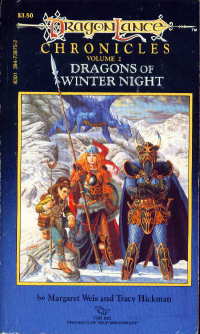
Courtesy of Wikimedia
I suppose that's why Laurana's front and center on the cover.  Tas gets honorable mention for repeatedly figuring things out as a side effect of curiosity.  And Kitiara, of course, who killed Sturm, whose death didn't really bother me.  Kitiara should've recognized him before killing him, though.

I guess we'll just cover the cover in this section then.  I basically kinda did that already.

Again, the original cover was done by Larry Elmore, and again, I couldn't find a good version of the full book cover I have beyond the one on Wikimedia.  If you want a high resolution version of the source image, you can find it on his website.  You can even buy prints!

(I wonder if Laurana would really wear her hair down with all that armor, though.  It has to constantly get caught in it.  I have long hair and it frequently gets caught and I don't even wear armor...)

Things to Wonder About

My post for Dragons of Autumn Twilight mentioned many things that I'd skipped or wondered about.  Let's see where we are, shall we?
  • How big is the world of Krynn? — Don't know.
  • What's up with the constellations disappearing? — Still don't really know.
  • Who are the Dragon Highlords? — They command the armies of the Dark Queen?
  • What are Dragonlances? — Ah!  I know this one, they are used to kill dragons.  And I actually think they are nothing but normal lances.  Not magic or anything.
  • What's the Cataclysm all about? — Apparently the gods turned their backs on Krynn, which caused meteors and death and destruction to rain down, changing the landscape permanently (seas became land, land became sea).  Many died.  Kinda like the Breaking of the World in The Wheel of Time.  Or the Cracking of the World in The Belgariad.  I sense a pattern.
  • Who is Fizban really? — Don't know yet (I mean, I do, but yeah).
  • What's up with the Green Gemstone Man? — Oh!  We see him again.  Towards the end.  Again.  Still don't know what's up.
  • Why is Raistlin obsessed with Fistandantilus? — Still don't know.
  • Where is Kitiara? — We got this one.  She's a Dragon Highlord.
And then this book introduced a few more things to wonder about:
  • What happened to all the draconians?  There weren't very many in this book.  And where did they even come from?
  • Why are there only bad dragons hanging around?  I mean, Silvara is presumably good, but no one is asking around for silver or good dragons.
  • What are the Towers of High Sorcery?
  • When are we going to learn more about the gods?  I guess we'll be learning along with everyone else, if the gods have been gone for 300+ years?
Maybe Book 3 will answer some of the still-open questions.

During the After

So a funny thing happened on the way to this post... I had all the notes for this post written up, and I decided to do some more research on Chronicles in general, because I knew for sure there was at least one other entry (Dragons of Summer Flame) that was released many years later, which I had never read.  Beyond that, I had no idea what else they might have done in the Dragonlance world, novel-wise.

Well, come to find, there's another trilogy called The Lost Chronicles that actually tells the stories of two of the skipped major events that I've spent half of this post complaining about!  They were written in the late-2000s and honestly I never knew they even existed.  I'm as shocked as you are.

I suppose you can chalk this up to my bad experiences with the other Dragonlance books outside of Chronicles and Legends (they are not good, as mentioned in my Retrospective Overview), which prompted me to give up on Dragonlance entirely.

Anyway, this trilogy consists of:
  • Dragons of the Dwarven Depths — tells the story of finding the Hammer of Kharas
  • Dragons of the Highlord Skies — tells the story of the Ice Wall, the defeat of Feal-thas and taking of the Dragon Orb
  • Dragons of the Hourglass Mage — tells the story of what Raistlin does off-screen in Dragons of Spring Dawning (I need to re-read it to remember what they skipped over!)
Holy Paladine has answered my prayers.  So now the question is...should I read those new entries as part of this Retrospective?  A new take on my Retrospective format, perhaps?

I'm actually interested in doing so, now that I know what they are about.  Let's see how I feel after I've actually gotten through the next trilogy, Legends.

Next:


Book 3 — Dragons of Spring Dawning


Previous:


Book 1 — Dragons of Autumn Twilight

Retrospective Overview