Just a quick update on The Hope of Memory, since I haven't posted on it for almost 2 months. I took a two week break on Wilders, as I just needed to get away from it for a while. Also, I've been working on iPad app, so that has taken up a bit of my time. And doing a bunch of reading (like video games, I always have a backlog to plow through). I started writing on the book again the other day, though.
Currently on my 9th yellow notepad, Chapter 27. Close to around 160K words, I estimate... so I'm definitely going to go over my goal of 180K, considering that I had 11 more chapters planned. However, some of the later ones will be shorter. And I will do a lot of trimming when it comes to the second draft. As soon as this draft is done, I'm moving back to finalize the first book, The Distant.
I plan to release that on Amazon only, and enroll in the KDP Select program (that's the lending library thing for Amazon Prime members). I believe the book has to be exclusive on Amazon to enroll if you are an Indie writer / publisher. At least I wasn't able to enroll Bonebearer because of that (since it's also on B&N).
I also want to make a print version... will look into Amazon's CreateSpace for that. Just need to make a decent cover. If anyone is interested in doing 3 fantasy / sci-fi covers for super cheap or nothing (either way, part of the payment would be what little exposure I have now), please post here or contact me. I am open to anything, as long as it looks cool.
Friday, December 7, 2012

Tuesday, November 20, 2012
Vampires & Witches: Hijacked by Taltos
Most people who have been engaged in popular culture or fiction at some level during the last 20 years are probably familiar with Anne Rice and one or two of her "gothic horror/fiction" novels, notably The Vampire Chronicles, that revolve around vampires. She also wrote a trilogy regarding witches, called Lives of the Mayfair Witches, whose characters eventually crossed over into The Vampire Chronicles. And if you lump in the two "outrigger" New Tales of the Vampires novels she did, you end up with fifteen novels total regarding the supernatural world of vampires and witches.
After many years of putting it off, I finally finished the last few novels in this multiple series amalgam, and much like the Chung Kuo review / commentary I did a few months ago, the ending left me a bit dissatisfied and bewildered, and I felt compelled to say something about these works as a result.
Please note that this post contains spoilers for all books in the three series listed above. If you plan on reading all of them and don't want anything spoiled for you, stop reading now and come back when you've finished. There will not be another warning.
If you've already read it or just don't care, read on.
And then there was The Witching Hour. I haven't read all of Rice's works, but I've read most, and I think this is by far her finest novel. The rich and eerie history of the Mayfair family made for a 1,000 page page-turner with a shocking, cliffhanger ending. I couldn't wait for the next book in the series.
I got heavily into both series after that. I re-read them. A few more came out and then the movie adaptation of the first vampire novel, Interview With the Vampire, staring Tom Cruise and Brad Pitt, opened and Anne Rice was a common household name. I went to that movie on opening night in college and loved it. A couple of years later, in 1997, I visited New Orleans over spring break with my older brother and sister-in-law, saw some of the landmarks mentioned in the series, took a guided "ghost and vampire" tour at night, and even stopped by Anne Rice's house on First Street to see it for myself.

Soon, however, she introduced the Mayfairs into the vampire storyline, starting with Merrick in 2000. It seemed inevitable since both series involved The Talamasca. I wasn't that thrilled with the book, though. I got the rest of the books as they came out, but stopped after reading 2001's Blood and Gold (the 13th overall in the combined series) and watching the 2002 film Queen of the Damned (which unsuccessfully mashed together the books The Vampire Lestat and The Queen of the Damned). That movie sucked, they butchered the story and Stuart Townsend wasn't half as good as Tom Cruise in the role of Lestat. Rice has pretty much disowned that movie, from what I've read.

So I took a break and the last two books sat there. I figured I would get to them in a year, perhaps.
Wrong. I didn't read them until now, eight years later. They've been sitting on my bookshelves, untouched that entire time. I know it's eight years because I keep track of the dates for every book I buy (see my 2011 Media Consumption post to see how dorky I am) and my database says I bought the last volume, Blood Canticle, on 10/2/2004. And it's definitely old... the top edge of the pages has yellowed over time.
So in trying to get through my incessant backlog, I finally read the last two books. I had to read synopses of the earlier books in preparation because I hadn't touched them in years. I wasn't sure what I was in for. I knew Rice had left New Orleans after the death of her husband in 2002, and that she had rejoined the Church and had written fictionalized accounts of Jesus Christ. But not much else, as I had lost interest in her after she stopped the vampire and witch novels.
The best order to read them, of course, is the order they were published in. The italic abbreviations are the series and volume. I also categorize them into three types: Lestat, Witches and Memoir. The letter(s) in brackets represent those. Some books are more than one.
Here are all fifteen:
Lestat is undoubtedly the central character. It's more about him than anyone else, and Anne Rice eventually went post-modern, having Lestat publish the earlier volumes in The Vampire Chronicles within the series itself, for the world to read as fiction and newer vampires to learn from.
Now, I think it's obvious that as the popularity of the series rose (particularly with the Tom Cruise movie in 1994), Rice focused solely on vampires and rode the wave of success. Whether this burned her out, or she tired of it due to her husband's death in 2002 and rushed it (she finished the last volume, Blood Canticle, just two months before he died), or ran out of ideas and just came up with a quick way to "resolve" both series and fulfill contractual obligations at the same time... I don't know. And it doesn't really matter. What matters is that two series that started out fantastic and strong, were mashed together and died with a whimper.
First, as I mentioned before, there probably shouldn't have been a definitive ending to either series. The vampires are immortal. That series is a mish-mash of various stories and memoirs. For something like that you just leave it open-ended. Maybe you come back to it, maybe you don't. The witches continue to be witches in the modern day, but perhaps use their powers for "good," like Rowan Mayfair does with the Mayfair Medical Center (or so we believe at first). But the fact that the last book, Blood Canticle, actually says "THE END" with a date, when none of the other books do, makes it clear Rice was ending it all.
Second, I just have one word:
Taltos.
The introduction of the Taltos in Lasher (Book 2 of the Mayfair Witches), essentially ruined everything for me. Everything. Rice went from a fantastic book about witches (The Witching Hour) and turned it into some story about this ancient race of beings that are roughly 7 feet tall, are born aware, grow to human size soon after birth, live for thousands of years, etc etc. It's obviously inspired by the táltos of Hungarian mythology.
With the books Lasher and Taltos, however, what made The Witching Hour so awesome (the Mayfair family history) was mostly thrown out the window. Lasher the Mayfair Ghost becomes Lasher the Taltos (instead of just a human), he's obsessed with perpetuating his race (he dies instead) and the third book in that series, Taltos, focusing on more Taltos births by the Mayfairs, was horrible. The surviving Taltos disappear at the end and it's left unresolved. I hated it and the direction Rice had gone.
In fact, Lasher upset me so much that I ended up donating it to the public library. I never bought Taltos, I merely borrowed it from a friend when it came out, and I'm glad I didn't waste any money on it. So that's why both are missing from my book picture above.
Wrong. Rice introduced the Mayfairs into the vampire storyline in Merrick, where the eponymous, outcast quadroon of a Mayfair becomes a vampire. Which ends up ultimately being pointless since she abruptly kills herself a few years later at the end of Blackwood Farm, which I thought was a pretty good novel, especially that late in the series.
I personally think Rice writes best when the story involves a personal or family history. Each one of those she has done has been quite engrossing. The best books in these series are memoirs / histories. The others, set in modern times, are weaker overall. Rice has mentioned that she had trouble getting her ideas about the world down when writing through normal human characters, but had better success once she turned to non-humans. This equates to past vs. present as well, it seems to me.

But is it truly the end of the series for Rice? In recent years she has left the Catholic Church (again) and turned back to some supernatural fiction with The Wolf Gift (her take on werewolves) and the Songs of the Seraphim series (about an assassin).
There's also something new she's working on called Born for Atlantis, which according to this November 2011 interview on The Daily Beast, is about:
I don't know about you, but I would be surprised if this new book didn't feature Tommy Blackwood (from Blackwood Farm, Quinn's nephew) somehow, since he says many times that he wants to search for Atlantis when he gets older. Could Rice tie this back into the Vampire Chronicles somehow?
She also mentions in the interview that she's working on something involving aliens. Now, I've always thought that she should expand the Vampire Chronicles to the future somehow. Enough with the books set in modern times or past memoirs. Take it further.
Restart the series by jumping ahead a few hundred years. What would Lestat be like he future? Quinn after a few hundred years of vampire life? Would they still be able to hide from society like they can now? I don't think anyone has done a good take on vampires in the future yet (if anyone has any recommendations, I'm all ears). The only decent part of Blood Canticle was the possibility of Rowan and her medical clinic getting a sample of Lestat's blood to analyze. What would happen should modern day scientists understand vampirism on a scientific level?
Will we ever know? Rice isn't known for science fiction, but she is planning the "alien" thing, and she's got good enough chops for fantasy and historical fiction - so she could pull it off. You don't have to be technical or necessarily understand certain technologies in order to write an engrossing story set in the future or in space.
I can only hope she returns to the vampires at some point, which would turn the crappy ending into just another crappy middle book we can ignore. But unlike Chung Kuo, there won't be a "remastering" of the end. We're stuck with it.
Damn you, Taltos! *shakes fist*
Next:
[Books 16-17] Prince Lestat and Two New Vampire Books
After many years of putting it off, I finally finished the last few novels in this multiple series amalgam, and much like the Chung Kuo review / commentary I did a few months ago, the ending left me a bit dissatisfied and bewildered, and I felt compelled to say something about these works as a result.
Please note that this post contains spoilers for all books in the three series listed above. If you plan on reading all of them and don't want anything spoiled for you, stop reading now and come back when you've finished. There will not be another warning.
If you've already read it or just don't care, read on.
The Background
First, a little background. I discovered Anne Rice sometime in high school, probably around 1992. I don't remember how I found her works, but I quickly devoured everything that was out at the time, which was only the first three in The Vampire Chronicles and the first book in Lives of the Mayfair Witches, entitled The Witching Hour.
I was blown away by these books, particularly The Witching Hour. Anne Rice essentially set the standard for vampires in modern fiction, and I loved how realistic everything was, how the characters were tormented and struggling with their immortality and the fact they had to kill to survive, how they coped over the years. I loved the vampire history that Rice presented, how it actually explained the vampires' origin (a malevolent spirit infesting the blood) and how it melded with the modern world without being too cheesy. The thought of Lestat, the main vampire character throughout the series, being a modern-day rock star didn't sit with me well at first, but Rice made it work and I became a fan.
I was blown away by these books, particularly The Witching Hour. Anne Rice essentially set the standard for vampires in modern fiction, and I loved how realistic everything was, how the characters were tormented and struggling with their immortality and the fact they had to kill to survive, how they coped over the years. I loved the vampire history that Rice presented, how it actually explained the vampires' origin (a malevolent spirit infesting the blood) and how it melded with the modern world without being too cheesy. The thought of Lestat, the main vampire character throughout the series, being a modern-day rock star didn't sit with me well at first, but Rice made it work and I became a fan.
 |
| The infamous New Orleans First Street house Anne Rice used to live in, used for the setting of The Witching Hour. |
And then there was The Witching Hour. I haven't read all of Rice's works, but I've read most, and I think this is by far her finest novel. The rich and eerie history of the Mayfair family made for a 1,000 page page-turner with a shocking, cliffhanger ending. I couldn't wait for the next book in the series.
I got heavily into both series after that. I re-read them. A few more came out and then the movie adaptation of the first vampire novel, Interview With the Vampire, staring Tom Cruise and Brad Pitt, opened and Anne Rice was a common household name. I went to that movie on opening night in college and loved it. A couple of years later, in 1997, I visited New Orleans over spring break with my older brother and sister-in-law, saw some of the landmarks mentioned in the series, took a guided "ghost and vampire" tour at night, and even stopped by Anne Rice's house on First Street to see it for myself.

Ebb and Flow
After college my interest in her books came and went like the tide... I would read old and new in chunks, then take a break for a year or two before picking it back up again. I was severely disappointed in how the Mayfair Witches trilogy played out (more on that later), but continued to enjoy The Vampire Chronicles, though it did not seem like they were heading anywhere, the series reduced to individual memoirs with Lestat taking a backseat. I figured she'd leave it open-ended and write a book from time to time. I mean, how do you end a series about immortals?
Soon, however, she introduced the Mayfairs into the vampire storyline, starting with Merrick in 2000. It seemed inevitable since both series involved The Talamasca. I wasn't that thrilled with the book, though. I got the rest of the books as they came out, but stopped after reading 2001's Blood and Gold (the 13th overall in the combined series) and watching the 2002 film Queen of the Damned (which unsuccessfully mashed together the books The Vampire Lestat and The Queen of the Damned). That movie sucked, they butchered the story and Stuart Townsend wasn't half as good as Tom Cruise in the role of Lestat. Rice has pretty much disowned that movie, from what I've read.

So I took a break and the last two books sat there. I figured I would get to them in a year, perhaps.
Wrong. I didn't read them until now, eight years later. They've been sitting on my bookshelves, untouched that entire time. I know it's eight years because I keep track of the dates for every book I buy (see my 2011 Media Consumption post to see how dorky I am) and my database says I bought the last volume, Blood Canticle, on 10/2/2004. And it's definitely old... the top edge of the pages has yellowed over time.
So in trying to get through my incessant backlog, I finally read the last two books. I had to read synopses of the earlier books in preparation because I hadn't touched them in years. I wasn't sure what I was in for. I knew Rice had left New Orleans after the death of her husband in 2002, and that she had rejoined the Church and had written fictionalized accounts of Jesus Christ. But not much else, as I had lost interest in her after she stopped the vampire and witch novels.
The Books
Now, altogether I'm talking about fifteen books technically broken into three different series. However, due to the crossover towards the end of The Vampire Chronicles, and the fact that two separate New Tales of the Vampires books are really no different than the other memoirs in the main sequence (and that Rice had seemingly given up on that grouping), they are part of the same world and should be read together, in my opinion. The later entries in the Chronicles will definitely make more sense if you've read the Mayfair Witches.
The best order to read them, of course, is the order they were published in. The italic abbreviations are the series and volume. I also categorize them into three types: Lestat, Witches and Memoir. The letter(s) in brackets represent those. Some books are more than one.
Here are all fifteen:
- Interview With the Vampire (1976) - tVC 1 [L, M]
- The Vampire Lestat (1985) - tVC 2 [L, M]
- The Queen of the Damned (1988) - tVC 3 [L]
- The Witching Hour (1990) - LotMW 1 [W]
- The Tale of the Body Thief (1992) - tVC 4 [L]
- Lasher (1993) - LotMW 2 [W]
- Taltos (1994) - LotMW 3 [W]
- Memnoch the Devil (1995) - tVC 5 [L]
- Pandora (1998) - NTotV 1 [M]
- The Vampire Armand (1998) - tVC 6 [M]
- Vittorio, the Vampire (1999) - NTotV 2 [M]
- Merrick (2000) - tVC 7 [L, W]
- Blood and Gold (2001) - tVC 8 [M]
- Blackwood Farm (2002) - tVC 9 [L, W, M]
- Blood Canticle (2003) - tVC 10 [L, W]
Lestat is undoubtedly the central character. It's more about him than anyone else, and Anne Rice eventually went post-modern, having Lestat publish the earlier volumes in The Vampire Chronicles within the series itself, for the world to read as fiction and newer vampires to learn from.
Now, I think it's obvious that as the popularity of the series rose (particularly with the Tom Cruise movie in 1994), Rice focused solely on vampires and rode the wave of success. Whether this burned her out, or she tired of it due to her husband's death in 2002 and rushed it (she finished the last volume, Blood Canticle, just two months before he died), or ran out of ideas and just came up with a quick way to "resolve" both series and fulfill contractual obligations at the same time... I don't know. And it doesn't really matter. What matters is that two series that started out fantastic and strong, were mashed together and died with a whimper.
 |
| My Anne Rice books. Yes, two are missing. Read on to find out why. I also lost the dust jacket for The Vampire Armand, that's why it's open to the title page in the pic. |
The Beginning of the End
So... why don't I like the ending? How did it die out?
First, as I mentioned before, there probably shouldn't have been a definitive ending to either series. The vampires are immortal. That series is a mish-mash of various stories and memoirs. For something like that you just leave it open-ended. Maybe you come back to it, maybe you don't. The witches continue to be witches in the modern day, but perhaps use their powers for "good," like Rowan Mayfair does with the Mayfair Medical Center (or so we believe at first). But the fact that the last book, Blood Canticle, actually says "THE END" with a date, when none of the other books do, makes it clear Rice was ending it all.
Second, I just have one word:
Taltos.
 |
| Oh Anne... why did you have to go there? |
The introduction of the Taltos in Lasher (Book 2 of the Mayfair Witches), essentially ruined everything for me. Everything. Rice went from a fantastic book about witches (The Witching Hour) and turned it into some story about this ancient race of beings that are roughly 7 feet tall, are born aware, grow to human size soon after birth, live for thousands of years, etc etc. It's obviously inspired by the táltos of Hungarian mythology.
With the books Lasher and Taltos, however, what made The Witching Hour so awesome (the Mayfair family history) was mostly thrown out the window. Lasher the Mayfair Ghost becomes Lasher the Taltos (instead of just a human), he's obsessed with perpetuating his race (he dies instead) and the third book in that series, Taltos, focusing on more Taltos births by the Mayfairs, was horrible. The surviving Taltos disappear at the end and it's left unresolved. I hated it and the direction Rice had gone.
In fact, Lasher upset me so much that I ended up donating it to the public library. I never bought Taltos, I merely borrowed it from a friend when it came out, and I'm glad I didn't waste any money on it. So that's why both are missing from my book picture above.
The Crossover
I figured, okay, the Mayfair Witches was ruined, but I still had The Witching Hour, a fantastic book I'd gladly read again without bothering to read the sequels. And The Vampire Chronicles were still decent. I enjoyed the different memoirs that Rice was doing, focusing on familiar characters like Armand, Pandora and Marius, as well as some new ones like Vittorio and later in Blackwood Farm, Tarquin Blackwood. At least she hadn't screwed that up, right?
Wrong. Rice introduced the Mayfairs into the vampire storyline in Merrick, where the eponymous, outcast quadroon of a Mayfair becomes a vampire. Which ends up ultimately being pointless since she abruptly kills herself a few years later at the end of Blackwood Farm, which I thought was a pretty good novel, especially that late in the series.
I personally think Rice writes best when the story involves a personal or family history. Each one of those she has done has been quite engrossing. The best books in these series are memoirs / histories. The others, set in modern times, are weaker overall. Rice has mentioned that she had trouble getting her ideas about the world down when writing through normal human characters, but had better success once she turned to non-humans. This equates to past vs. present as well, it seems to me.
Blood Canticle
So as I mentioned, I liked Blackwood Farm, the penultimate novel in the series. It was well done and interesting, had a good main character (Tarquin "Quinn" Blackwood) and a nice twist to the end which I didn't see coming. While I didn't find the way Quinn interacted with his family and black house staff all that believable (maybe it's just because I wasn't raised in the South), I liked everything else. It ends on a slight cliffhanger and I moved immediately into the last novel, Blood Canticle.
This book has gotten panned in many reviews, and I'm going to have to add my voice to theirs. It's not very good and is a far cry from the classic Rice novels. Lestat is obsessed with becoming a saint now and just doesn't act like he used to. This book is a mess, and reminds me of how Chung Kuo originally ended. So like that blog post, here's a rundown of how ridiculous this book gets.
1: Anne Rice chastises her readership
This is the first novel since 1995's Memnoch the Devil to be narrated by Lestat. And the very beginning is him chastising you, the reader, for not liking his last book, Memnoch. I liked that book, but a lot of others didn't. And I suppose it's in character... but it felt petty to me. It reminded me of the movie Lady in the Water, when after taking a lot of criticism for his last few movies, writer / director M. Night Shyamalan cast himself as a character who's written works which will someday "change the world" and where a film critic in the movie meets a violent end.
2: Mona Mayfair becomes a vampire
Stop turning everyone into a vampire, Rice! Lestat does this for Quinn, and everyone's lives are turned upside down. Mona was near death, but now they have to find a way to explain to the persistent Mayfairs (Rowan and Michael) how she miraculously recovered. Lestat has blown their cover, and Quinn is mostly to blame since he can't let go of his mortal life. It's an interesting storyline, one that makes Blackwood Farm interesting, but here it just turns into a mess and precipitates all that comes later.
3: Lestat falls in love with Rowan Mayfair
This just feels wrong to me. Why did this need to happen? If you've read both series you know how weird this seems. Rowan has gone to hell and back through the Mayfair Witches, and throwing all this vampire stuff on top of that is overkill. Besides, I don't really like Rowan all that much after the events of The Witching Hour.
4: Drug runners in the Caribbean
Mona, now that she's a vampire, wants to find out what happened to her Taltos baby, named Morrigan. Rowan and Michael tried to find her and Ash Templeton (the older Taltos who ran off with her at the end of Taltos) but eventually gave up. Of course Maharet knows and tells Lestat via email, and within minutes they are off to the Caribbean island where the Taltos have hidden themselves - only to find it occupied by South American drug runners and the remaining Taltos captured. Lestat and Co. just go through and kill all the drug runners in an extended action sequence featuring Matrix-style telekinesis and pyrokinesis that feels out of place.
5: The Taltos' efforts were POINTLESS
The ultimate insult is when you find out what happened to Ash, Morrigan and their Taltos children. The children rebel, kill the parents, and fight amongst themselves. Lasher spent hundreds of years manipulating the Mayfair's lineage so that he could be reborn in a Taltos to restart the race - and they failed. They were not meant for this time, and cannot survive it in great numbers. So all this crap was for nothing. THEY FAILED. And both series were ruined.
6: It's anticlimactic
Huh? This sprawling saga about vampires and witches "ends" like this? Usually when you end something, there's some kind of resolution. The only resolution you get here is for the ill-begotten Taltos storyline that should have never been introduced in the first place, and the resolution isn't even any good!
 |
| I guess the cover is okay... |
This book has gotten panned in many reviews, and I'm going to have to add my voice to theirs. It's not very good and is a far cry from the classic Rice novels. Lestat is obsessed with becoming a saint now and just doesn't act like he used to. This book is a mess, and reminds me of how Chung Kuo originally ended. So like that blog post, here's a rundown of how ridiculous this book gets.
1: Anne Rice chastises her readership
This is the first novel since 1995's Memnoch the Devil to be narrated by Lestat. And the very beginning is him chastising you, the reader, for not liking his last book, Memnoch. I liked that book, but a lot of others didn't. And I suppose it's in character... but it felt petty to me. It reminded me of the movie Lady in the Water, when after taking a lot of criticism for his last few movies, writer / director M. Night Shyamalan cast himself as a character who's written works which will someday "change the world" and where a film critic in the movie meets a violent end.
2: Mona Mayfair becomes a vampire
Stop turning everyone into a vampire, Rice! Lestat does this for Quinn, and everyone's lives are turned upside down. Mona was near death, but now they have to find a way to explain to the persistent Mayfairs (Rowan and Michael) how she miraculously recovered. Lestat has blown their cover, and Quinn is mostly to blame since he can't let go of his mortal life. It's an interesting storyline, one that makes Blackwood Farm interesting, but here it just turns into a mess and precipitates all that comes later.
3: Lestat falls in love with Rowan Mayfair
This just feels wrong to me. Why did this need to happen? If you've read both series you know how weird this seems. Rowan has gone to hell and back through the Mayfair Witches, and throwing all this vampire stuff on top of that is overkill. Besides, I don't really like Rowan all that much after the events of The Witching Hour.
4: Drug runners in the Caribbean
Mona, now that she's a vampire, wants to find out what happened to her Taltos baby, named Morrigan. Rowan and Michael tried to find her and Ash Templeton (the older Taltos who ran off with her at the end of Taltos) but eventually gave up. Of course Maharet knows and tells Lestat via email, and within minutes they are off to the Caribbean island where the Taltos have hidden themselves - only to find it occupied by South American drug runners and the remaining Taltos captured. Lestat and Co. just go through and kill all the drug runners in an extended action sequence featuring Matrix-style telekinesis and pyrokinesis that feels out of place.
5: The Taltos' efforts were POINTLESS
The ultimate insult is when you find out what happened to Ash, Morrigan and their Taltos children. The children rebel, kill the parents, and fight amongst themselves. Lasher spent hundreds of years manipulating the Mayfair's lineage so that he could be reborn in a Taltos to restart the race - and they failed. They were not meant for this time, and cannot survive it in great numbers. So all this crap was for nothing. THEY FAILED. And both series were ruined.
6: It's anticlimactic
Huh? This sprawling saga about vampires and witches "ends" like this? Usually when you end something, there's some kind of resolution. The only resolution you get here is for the ill-begotten Taltos storyline that should have never been introduced in the first place, and the resolution isn't even any good!

The End?
So... the series came to a somewhat ignominious end (at least for me). I am not happy with it. I understood why Chung Kuo ended as it did. I don't understand why Rice ended with Blood Canticle. It's just not a good book or idea compared to the earlier entries.
But is it truly the end of the series for Rice? In recent years she has left the Catholic Church (again) and turned back to some supernatural fiction with The Wolf Gift (her take on werewolves) and the Songs of the Seraphim series (about an assassin).
There's also something new she's working on called Born for Atlantis, which according to this November 2011 interview on The Daily Beast, is about:
"...several immortals sent to the planet during the time of Atlantis and it tells the story of what happened. They're now still alive in the modern age and they're facing a crisis."
I don't know about you, but I would be surprised if this new book didn't feature Tommy Blackwood (from Blackwood Farm, Quinn's nephew) somehow, since he says many times that he wants to search for Atlantis when he gets older. Could Rice tie this back into the Vampire Chronicles somehow?
She also mentions in the interview that she's working on something involving aliens. Now, I've always thought that she should expand the Vampire Chronicles to the future somehow. Enough with the books set in modern times or past memoirs. Take it further.
Restart the series by jumping ahead a few hundred years. What would Lestat be like he future? Quinn after a few hundred years of vampire life? Would they still be able to hide from society like they can now? I don't think anyone has done a good take on vampires in the future yet (if anyone has any recommendations, I'm all ears). The only decent part of Blood Canticle was the possibility of Rowan and her medical clinic getting a sample of Lestat's blood to analyze. What would happen should modern day scientists understand vampirism on a scientific level?
 |
| So who else had this book as a kid? |
Will we ever know? Rice isn't known for science fiction, but she is planning the "alien" thing, and she's got good enough chops for fantasy and historical fiction - so she could pull it off. You don't have to be technical or necessarily understand certain technologies in order to write an engrossing story set in the future or in space.
I can only hope she returns to the vampires at some point, which would turn the crappy ending into just another crappy middle book we can ignore. But unlike Chung Kuo, there won't be a "remastering" of the end. We're stuck with it.
Damn you, Taltos! *shakes fist*
Next:
[Books 16-17] Prince Lestat and Two New Vampire Books
Friday, October 26, 2012
The Belgariad [5] Enchanter's End Game (1984)

The final book of The Belgariad, we bring the two main storylines to conclusion. Garion is still skulking his way across the Angarak kingdoms towards Cthol Mishrak to confront the god Torak, and Ce'Nedra and company are leading the armies of the West into Mishrak ac Thull to distract the armies of the Murgos and Malloreans. For the conclusion of a five volume series, you'd think it would be exciting... however, much of the book is filler.
Before you continue:
- This is part 5 of my The Belgariad and The Malloreon retrospective
- See this blog post for an overview of the retrospective
- These blogs are most effective with your own re-read of both series
- Warning: CONTAINS SPOILERS FOR BOTH SERIES
General Thoughts
This book provides the ending we've all been expecting (Garion killing Torak, we're all saved, happy ending yay), but it takes a while to get there. Because there's not a lot for Garion to actually do (travel across mostly barren countryside in hiding and then fight Torak), the bulk of the book ends up following Ce'Nedra's storyline (and some of the Western rulers that were left behind to manage the kingdoms while the Kings are at war).
This makes for a book that starts out well, drags a bit in the middle, then ends excitingly. When you get to the end you're truly sad to see these characters go; they are fun and personable, and their banter has rubbed off on you. At least it did for me. They aren't the most complex fantasy characters - but they don't need to be for the reader to care about them. I think that's Eddings' greatest achievement with the series: as much as the world building seems lacking and plot elements are cliche, you still care about the characters.
Except for a few that are basically pointless. Like Lelldorin. He is mentioned in prophecy as the Archer, but ends up being worthless on top of stupid. What does he do? Gets hurt in Book 2 and disappears until Book 4, continues to be stupid, then goes with Ce'Nedra to fight like everyone else in Book 5. Never really liked this character. A bad version of Legolas from Lord of the Rings.
 |
| Lelldorin, being an idiot as usual. Garion, wondering "Why me?" as usual. If you are the owner of this picture, let me know so I can credit you, please. |
This time I think I'll do the blog backwards: cover, maps and kingdoms first, then discuss different parts of the ending.
The Cover
The cover here is alright, though once again there is a massive spoiler on the cover (Polgara covering a dead Durnik) that those who have been paying mild attention to the prophecies in the series will immediately get. She doesn't actually cover him like that in the story, but I suppose they were trying to hide his identity. It would have been nice to see him, though.

We have the map of Mallorea, where the confrontation between Garion and Torak will be, as well as Garion and Belgarath looking travel-worn and weary, wearing the requisite furs from their journey across cold Gar og Nadrak and Mallorea. Belgarath shouldn't have a long-ass beard, should he? Pretty sure he's not described with one.
The silhouette here is another mask - this time Torak's, with the burning eye of fire (Sauron, anyone?). However... the mask is supposed to just be one side of the face (the side that is disfigured). So Schwinger messed up there. Tsk tsk.
There are some other alternate covers of the series, but most are blah or not worth posting. One set is comprised of landscapes that almost look like they were drawn for something else and just reused for The Belgariad because it was close enough. However, I did find a few good covers for Enchanter's End Game - ones worthy enough to share.

Gar og Nadrak
This kingdom is home to one of the five Angarak tribes, the Nadraks. They are by far the most likable of any of the Angaraks, almost akin to the Drasnians in their penchant for trade, money and information. They have little love for Torak and the Grolims and later make for allies in the fight against the Murgos and Malloreans.

Garion, Belgarath and Silk travel through mining and fur trapping communities, are briefly captured by Mallorean army recruiters, then are captured by a Nadrak trader and taken to... none other than the Nadrak King, Drosta. The Ruler Streak lives!
The last part of this section deals with the party traveling across Morindland, a tundra-like waste far to the north. This is actually a really cool section, as the Morind worship and summon demons, and the people are somewhat savage, making for an interesting diversion from the norm and which sets up some background for more demon fun in The Malloreon.
Mishrak ac Thull
And finally, we visit the last kingdom in the western continent. Home of the Thulls, the idiot tribe of the Angaraks, this country is mostly hills and farmland once you get out of the mountains on the western border. Thulls are belittled throughout the series, considered stupid and good for nothing but manual labor and potential Grolim sacrifices. Thullish women are constantly pregnant since Grolims will not sacrifice pregnant women. This results is a proliferation of lackwit Thulls.

Anyway, Garion does not visit this country. Ce'Nedra and the armies of the West do. They end up in a big battle they weren't planning on and Ce'Nedra and company get captured by Malloreans and taken to their Emperor, 'Zakath. Some minor, 1D characters die in the fighting and we're a little sad.
As for the Ruler Streak... Garion does not meet King Gethell, but Ce'Nedra does. So it kinda ends here? Crap. Although Ce'Nedra is acting in Garion's stead as Overlord of the West. Still, he does appear on screen, which is the most important thing.
On a side note - why such a "stupid" people are allowed to govern and maintain a large nation never made much sense to me. You'd think the Angarak rulers would just take it over and use Thulls as slaves throughout Angarak, rather than letting them have their own huge country. *shrug*
Another side note - what's with the "og" and "ac" in the country names? Never understood that. It sounds cool, I guess, but it's like apostrophes sometimes (i.e. the one in 'Zakath, which we learn later actually stands for "Kal")... they look exotic but are generally pointless and a fantasy cliche at this point.
The Portage over the Eastern Escarpment
Before we move on to the last kingdom, I wanted to talk about this separately, as I've always felt it was a little ridiculous.
Part of the Western armies' plan involves portage of the massive Cherek warships across the Eastern Escarpment - a huge cliff that comprises the eastern border of Algaria. They plan to sail the ships down the River Aldur as far as they can go, then cart them across leagues of grassland, then up and over the escarpment using sophisticated pulley systems created by the Drasnians, then cart them again over leagues of mountainous western Mishrak ac Thull until they get to the River Mardu, whereupon they can sail into the Sea of the East and start having fun sinking Mallorean ships.
Really? Weren't not talking about canoes here, these are huge ships that have a crew of at least a hundred.
 |
| Here's a real portage |
It has always struck me as ridiculous and implausible. These people are not that advanced and practice little science. There is not a lot of detail on how they do this, it just kind of happens in the background, with some clever suggestions by Durnik. It's true that the Angaraks would not expect such a bold and daring move - yet all the same, the ease with which it's pulled off has always been one of my little gripes with the realism of the series. Maybe it's just me.
Mallorea
Ah, boundless Mallorea, as they refer to it sometimes. Mallorea is much larger than what is shown here, as we'll learn in The Malloreon. Here we only see the barren northwestern portion, where Torak's dead city of Cthol Mishrak lies. All the major characters conveniently meet up there, as 'Zakath turns Ce'Nedra and the others over to the Grolims, who bring them across the sea to Zedar the Apostate, guardian of Torak's body, in Cthol Mishrak.

Other than the fight with Torak, the only interesting thing that happens here is Garion, Belgarath and Silk being chased by the Hounds of Torak, Grolims who were transformed into giant hounds and left to guard Cthol Mishrak.
The Ruler Streak kind of came crashing down in the last kingdom, but Ce'Nedra does meet the Emperor of Mallorea, 'Zakath, so... whatever.
Garion vs. Torak
And now we come to it... the final confrontation, what we've been building up to for... a book and a half. When you read it for the first time, you might be a little disappointed. Thousands of years of prophecy for a mere sword fight? It's like when I first saw The Matrix (and Roger Ebert summed up my thoughts on that movie more succinctly) - when Neo learned who he was, it all came down to a little fist fight with Agent Smith. In the context of the story it just didn't fit for me, but I can understand why they did it.
Same for here... only it's not about a sword fight, which is good. It's about rejection. The first is from Polgara, who has to resist him somehow. She is able to do this because of Durnik's death and the realization of her love for him. The second is from Garion, who shows him how no one, not even his Angarak people nor his parents (UL and the Universe) love him. With the realization that he is utterly alone, this allows him to grow sloppy, providing the opening for Garion to kill him with the Orb-flamed sword of the Rivan King.
And so the God who never should have been dies, and the mistake was corrected... or as we find out, not just yet.
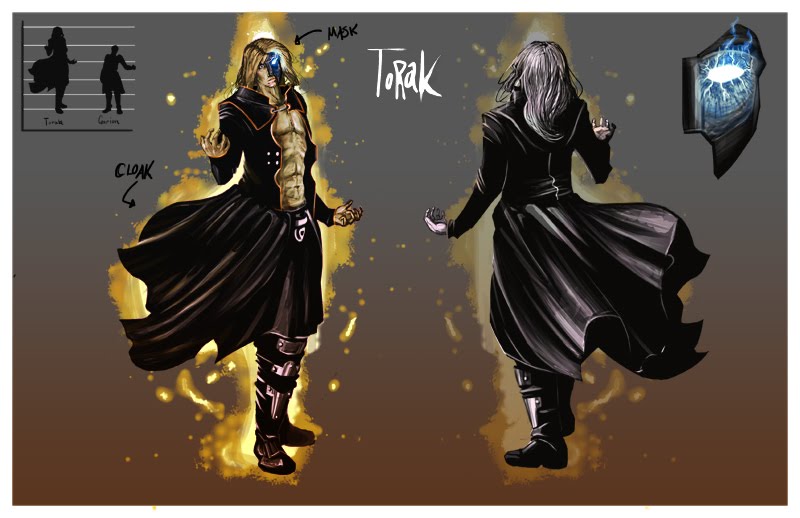
I stumbled across a blog by Zach Alexander with some decent fan art / character designs. Below are Garion and Torak, by far the best ones I've seen (although I think Garion looks like Joffrey in the Game of Thrones HBO series). Check the link here for more (Silk, Barak, Ce'Nedra).

Durnik and Polgara
This is probably my favorite part of the series. Not because Durnik has to die (we know he's coming back, he's The Man With Two Lives, remember?), but because their love is finally realized. Durnik has always loved Polgara, but they could never be. He is a mortal, not a sorcerer - the union could not last. And Polgara has never had a normal life or love, and she's spent centuries sacrificing herself to ensure Garion came into being. So to finally see them both get what they want - it's heartwarming.
And even though you know Durnik will be back, the anguish Polgara shows when he dies is very touching. It's a completely different Polgara than we've seen. We already know about Belgarath's grief over his wife, Poledra, and he felt more human than Polgara throughout most of the series. She doesn't get too emotionally attached to people outside the sorcerer's circle since she knows she will outlive them.
Then later, when we discover that Durnik was given the Will and the Word after his resurrection rather than Polgara having hers removed... very nice moment. I immediately wondered if he was going to be called Beldurnik, like the other "good" male sorcerers. As we find out in The Malloreon, that doesn't happen. Which is good, because I think it sounds awkward.
Also found some fan art of Durnik and Polgara by an artist named Oboe. There are some others there too; Ce'Nedra, Barak and Mandorallen. Durnik is so plain and unassuming you probably wouldn't even know it was him unless I said so... the portrait could be of any normal person. Polgara, of course, is easily recognizable with her distinctive white lock of hair.


What's Next?
I'm sure Eddings did not have The Malloreon planned when he wrote The Belgariad, based on the way some characters act and what they say (referring to Garion vs. Torak as the final confrontation). The great success of the first series surely prompted Lester Del Rey to ask Eddings for a sequel of some sort.
So... we're not done just yet with Garion and Friends. Another meeting of the Child of Light and Child of Dark is in the works. This time to completely fix the mistake that was the birth of Torak.
In the next series, The Malloreon, our heroes travel the breadth and width of the eastern continent, Mallorea, giving us a whirlwind tour of the rest of Eddings' world. There will be more maps and more peoples to discuss, many of them godless, and many new friends and allies. I actually like the sequel series better than The Belgariad, which to me is now just an extended prologue, a setup for the much better sequel. The Malloreon is more adult in focus and more entertaining in general, in my opinion, since Garion is an adult now - much the way the second half of the Harry Potter series is so much better than the first half because Harry is older and has more serious adventures.
Next:
The Malloreon
Book 1 - Guardians of the West
Previous:
The Belgariad
Book 4 - Castle of Wizardry
Book 3 - Magician's Gambit
Book 2 - Queen of Sorcery
Book 1 - Pawn of Prophecy
All maps by Shelly Shapiro
Subscribe to:
Posts (Atom)