Monday, June 29, 2020

Dragonlance: Chronicles [2] Dragons of Winter Night (1985)


I remember this book now.  It's the one that annoyingly skips interesting events like quests and battles to detail the boring events in between them, such as traveling and holding councils where the speeches are elided and glossed over with a few sentences.  And what's worse, the interesting events that preface the first two parts of the book are told with long poems.  We don't even get complete flashbacks!  Rude.

This unfortunately is a by-product of basing the story off gaming sessions, as there were numerous AD&D modules developed along with the creation of Krynn—modules that cover those skipped events.  In choosing what to cover in the novels, they wanted to let players experience certain events and details only while gaming, and use the novels to cover the more "non-playable" gaps between them and give Dungeon Masters a "truer feeling for the game world."

That's great, but for those who just want to read the novels, it really feels like they should've switched things around.

More about that later... along with a surprise for me...

Before you continue:

  • This is Part 2 of my Dragonlance Retrospective
  • See this blog post for an overview of the Retrospective
  • These blogs are not plot recaps—they are most effective in conjunction with your own re-read of the series
  • Warning: CONTAINS SPOILERS FOR BOTH SERIES

After the Hammer of Kharas

Here begins the first time jump.  It's been a while since the end of Book 1, Dragons of Autumn Twilight.  There was what sounds like a really cool quest to find the Hammer of Kharas—which can be used to forge dragonlances—for the dwarves, but we start after the quest is over, in Thorbardin, mountain home of the dwarves.  All the action of that quest is told in a short poem.

Come on man, I wanted to read about that!  Sounds more interesting than what we do get, which is some traveling.

About the most interesting thing about the first part of the book is learning how so little is known about the world, 300 years after the Cataclysm.  People closed their lands to outsiders, no one communicated, and maps didn't get updated.  And thus it is that Tanis and company don't even know that the port of Tarsis is now landlocked!

Which seems hard to believe, honestly.  Tanis and the others have traveled quite a bit before our story begins.  Surely they didn't just stick to their little corner of the continent around Solace.  And I would think Raistlin would know, eh?  He's a smart guy.  Even he and Caramon went to the Tower of High Sorcery at Wayreth (though I was unable to find out exactly where on the continent that is) and surely people from Tarsis had travelled to other areas by then and told people it was landlocked...

But anyway.  We do get some decent action in Tarsis, which is where our party splits for the rest of the book (that's sooo Lord of the Rings).  One group (Sturm, Laurana, Flint, Tasslehoff) takes most of the focus from here on out.  The other group (Tanis, Caramon, Raistlin, Tika, Goldmoon, Riverwind) go through the paces, simply moving into position for the next book.

After the Ice Wall

And now, the second time jump, after the split at Tarsis.  I would've rather read about Sturm, Laurana, and Co. going to the Ice Wall and defeating Feal-Thas, getting the dragon orb, finding a dragonlance, etc.  Other than a brief dragonlance flashback, we instead get another poem and many chapters of traveling to and across Ergoth, which are not that exciting.

By omitting the Ice Wall quest, we don't get to see Laurana become a fighter and grow more confident in herself.  We get some of that when she confronts her father and older brother (Porthios) on Southern Ergoth, but it's not the same.

Other quick observations:
  • It's super obvious that Silvara is a silver dragon, based on how she talks of them and how she knows so much about Huma's tomb.
  • The tomb is cool but not very impactful because we're only on the second book written in the world of Dragonlance, and there hasn't been time for a legend to grow with readers.  Kinda like the Eye of the World in The Wheel of Time, where it appears in the first book, so doesn't seem so awe-inspiring when our heroes discover it, though it probably should be.
  • Fizban makes a reappearance for more comic relief, but as I stated in the blog for the first book, I'm not a fan of the character.  Too goofy and pulls me out of the story.  I don't think I'm going to talk about him anymore in this post.

The Illustrations

A quick aside about the chapter illustrations, to break up all the text a little.  No one wants to read a wall of text, right?

Instead of Valeria Valusek, who did the Dragons of Autumn Twilight illustrations, this book features interior art by Denis Beauvais, a Canadian artist who's done all kinds of work, from role playing games to comics.  Much of his work in this book is so similar to the style of Valusek, that I initially didn't realize it was a different illustrator.  I supposed for a series like this, that's probably a good thing. 

Here are the two from this book that I like the most:


After the Forging

Not a time jump this time, but rather a simple omission.  I would've much rather read about Theros Silverarm initially forging the dragonlances from the silver in Huma's tomb.  Instead, we get a lot from the perspective of the Knights of Solamnia, and how that group operates.

The Children of the Light from The Wheel of Time remind me of them—a very rigid group that tries to be honorable and pious, but is hypocritical.  Shocker, Sturm is the only one with true honor, and as usual, one of their leaders is power hungry and goes mad (which seems to happen a lot to military leaders in stories...gotta have conflict).  These early fantasies always have knights as honorable, good people, when in reality, knights were basically killing machines for nobility.  George R.R. Martin made them more realistic with A Song of Ice and Fire and it's hard for me to go back now.

Other quick observations:
  • The gnomes are basically gully dwarves part 2, only a bit more interesting.  You actually feel for Gnosh when the dragon orb is destroyed by Tasselhoff.
  • The Green Gemstone Man appears again at the end of the book.  I had forgotten about him from the first book, actually, and I've forgotten exactly what his purpose is at the end.  So I guess I'll be surprised about something in Book 3!
  • Finally, Kitiara officially appears, after so much talk about her.  Of course, she was obviously the Highlord in Tarsis that gave chase to the griffons that took Tanis, Alhana, and company to Silvanesti.

The Elven Heroine

In another callback to Lord of the Rings... Laurana feels like a new version of Eowyn, a woman who wasn't supposed to fight like the men.  But Laurana takes it further and continually does what she's not supposed to do and grows exponentially as a character for it, one of the few that do in this series.

The climax at the High Clerist's Tower was good though the battles are largely skipped—it's like Weis & Hickman don't want to write battles?  Literally all of them are skipped or glossed over (they want you to game it instead).  But Laurana... she's the best part, and becomes the hero of this book.  It's certainly not Tanis or anyone in that group, who just wander around all book.
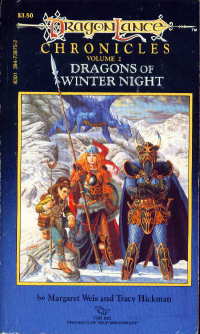
Courtesy of Wikimedia
I suppose that's why Laurana's front and center on the cover.  Tas gets honorable mention for repeatedly figuring things out as a side effect of curiosity.  And Kitiara, of course, who killed Sturm, whose death didn't really bother me.  Kitiara should've recognized him before killing him, though.

I guess we'll just cover the cover in this section then.  I basically kinda did that already.

Again, the original cover was done by Larry Elmore, and again, I couldn't find a good version of the full book cover I have beyond the one on Wikimedia.  If you want a high resolution version of the source image, you can find it on his website.  You can even buy prints!

(I wonder if Laurana would really wear her hair down with all that armor, though.  It has to constantly get caught in it.  I have long hair and it frequently gets caught and I don't even wear armor...)

Things to Wonder About

My post for Dragons of Autumn Twilight mentioned many things that I'd skipped or wondered about.  Let's see where we are, shall we?
  • How big is the world of Krynn? — Don't know.
  • What's up with the constellations disappearing? — Still don't really know.
  • Who are the Dragon Highlords? — They command the armies of the Dark Queen?
  • What are Dragonlances? — Ah!  I know this one, they are used to kill dragons.  And I actually think they are nothing but normal lances.  Not magic or anything.
  • What's the Cataclysm all about? — Apparently the gods turned their backs on Krynn, which caused meteors and death and destruction to rain down, changing the landscape permanently (seas became land, land became sea).  Many died.  Kinda like the Breaking of the World in The Wheel of Time.  Or the Cracking of the World in The Belgariad.  I sense a pattern.
  • Who is Fizban really? — Don't know yet (I mean, I do, but yeah).
  • What's up with the Green Gemstone Man? — Oh!  We see him again.  Towards the end.  Again.  Still don't know what's up.
  • Why is Raistlin obsessed with Fistandantilus? — Still don't know.
  • Where is Kitiara? — We got this one.  She's a Dragon Highlord.
And then this book introduced a few more things to wonder about:
  • What happened to all the draconians?  There weren't very many in this book.  And where did they even come from?
  • Why are there only bad dragons hanging around?  I mean, Silvara is presumably good, but no one is asking around for silver or good dragons.
  • What are the Towers of High Sorcery?
  • When are we going to learn more about the gods?  I guess we'll be learning along with everyone else, if the gods have been gone for 300+ years?
Maybe Book 3 will answer some of the still-open questions.

During the After

So a funny thing happened on the way to this post... I had all the notes for this post written up, and I decided to do some more research on Chronicles in general, because I knew for sure there was at least one other entry (Dragons of Summer Flame) that was released many years later, which I had never read.  Beyond that, I had no idea what else they might have done in the Dragonlance world, novel-wise.

Well, come to find, there's another trilogy called The Lost Chronicles that actually tells the stories of two of the skipped major events that I've spent half of this post complaining about!  They were written in the late-2000s and honestly I never knew they even existed.  I'm as shocked as you are.

I suppose you can chalk this up to my bad experiences with the other Dragonlance books outside of Chronicles and Legends (they are not good, as mentioned in my Retrospective Overview), which prompted me to give up on Dragonlance entirely.

Anyway, this trilogy consists of:
  • Dragons of the Dwarven Depths — tells the story of finding the Hammer of Kharas
  • Dragons of the Highlord Skies — tells the story of the Ice Wall, the defeat of Feal-thas and taking of the Dragon Orb
  • Dragons of the Hourglass Mage — tells the story of what Raistlin does off-screen in Dragons of Spring Dawning (I need to re-read it to remember what they skipped over!)
Holy Paladine has answered my prayers.  So now the question is...should I read those new entries as part of this Retrospective?  A new take on my Retrospective format, perhaps?

I'm actually interested in doing so, now that I know what they are about.  Let's see how I feel after I've actually gotten through the next trilogy, Legends.

Next:


Book 3 — Dragons of Spring Dawning


Previous:


Book 1 — Dragons of Autumn Twilight

Retrospective Overview

Monday, May 25, 2020

Prince Lestat and the Blood Communion

So here we are, Blood Communion, another Vampire Chronicles novel.  I'm putting this down as Book 18 in my Vampires / Witches chronology, though to be honest, with some of the latter crossover novels being ignored (essentially rendered non-canon) by Anne Rice, it's probably not necessary anymore.  But given the way Atlantis was brought into the Chronicles, and that the Talamasca still exists, it's all a shared world to me.

Over/under on the Wolf Gift Chronicles crossing over into the shared Vampire universe?  I figure when she finally gets interested in doing another of those, Lestat will be in it.  Especially after what happens in this new entry.  It's fairly short, so my post will be too.

Please note that this post may contain spoilers for all books in Anne Rice's vampires and witches series.  If you plan on reading all of them and don't want anything spoiled for you, stop reading now and come back when you've finished.  There will not be another warning.


A Cumbersome Title

I guess the title of the novel is technically Blood Communion: A Tale of Prince Lestat, because we need "Lestat" in the title so people know it's a Vampire Chronicles novel that features Lestat, which must be the only series and character that fans of Anne Rice are interested in?

But if that's the case, why not call it Prince Lestat and the Blood Communion, following the same format of the previous entry, Realms of Atlantis?  It would feel more aligned with the previous two novels that way.  I don't understand titling or marketing sometimes...it's as if they always assume the audience is dumb or knows nothing about the existing franchise.  We're a dozen-plus novels into it here, I think those still following will get it.

More New Ancients

Before I started this novel, I was thinking, "I hope Rice doesn't again introduce a new really old vampire we've never heard of, you would think at this point, after so many novels and near-catastrophic events, that all of the ancient vampires would be known."  I mean, waaaay back in the third entry, Queen of the Damned, all vampires were doomed... and lots of ancients didn't reveal themselves afterward.  In Prince Lestat, all vampires were threatened by Amel, the vampiric spirit... and even that didn't prompt all the ancient vampires to reveal themselves.

Which is why, of course, right at the beginning of Blood Communion we meet Fontayne, a vampire made by Pandora, one we've never heard of before.  Since Pandora made him back in the day, he's like, really old.  I was rolling my eyes until I heard the explanation for his absence, which was actually pretty clever on Rice's part.  He had angered Arjun, Pandora's controlling fledgling, and on pain of death vowed never to reveal himself...until Arjun was killed by Marius towards the beginning of this novel.

So I'll let this one slide.  However—he seemed kind of pointless because after his introduction the rest of the novel is about the Benedict blood communion and Rhoshamandes aftermath and Fontayne only makes brief appearances.

There's also a few more new ancients, like Baudwin and Gundesanth, the latter showing up towards the end.  They had been friends with Gregory in ancient Egyptian times.  There's a lot more Rice could explore there.  I've been generally tired of vampire memoirs—let's focus on the future, rather than the past—but if Rice were going to do one more, a Gundesanth one would probably be interesting.

The Kidnapped Ancients

I actually thought Rice was killing off Louis, Gabrielle, and Marius.  Louis alone would've shocked me but all three at once?  The whole sequence from the kidnappings to their rescue was really well done, especially the part where Lestat kills Rhosh.  That was just badass and is now one of my favorite scenes from the entire Chronicles.

Though I liked the whole sequence, I was a little disappointed that at least one of them didn't die, and it was very fortunate that Lestat was able to find them based off the few words Rhosh screamed before dying.  How cool it would have been had they really died, or been left in their iron coffins, heads twisted backwards, only to be found many, many years later in a future Chronicles novel?

Alas, Rice probably doesn't plan that far ahead and anymore.  These new Prince Lestat novels are more like the Indiana Jones fast-moving serial adventures than anything else.

The Modern Ancient

I like the idea of Lestat essentially becoming one of the ancient ones that we've been reading about... over time they pass away (many ancients have died at this point) or give up on power, choosing a most unlikely ruler for the modern times.  Lestat has broken a lot of the vampire rules and he was chosen leader because of his selfless act of potentially sacrificing himself for all vampires when he gave himself up to Rhosh.

And because of that, all (most) of the vampires are now united in this modern, connected world.  The cults and splinter groups of vampires, like the Children of Satan, are all gone, and pretty much all of them know the history and how it all works.  Knowledge is power?

The rest of the book is kinda anticlimactic: long live Prince Lestat, he brings his village architect (forgot the name) into the Blood, and oh look Marius painted a cool mural of the whole gang, even the new (old) kids on the block like Fontayne.

But you know what... it actually works as a proper ending to the series, when you think of it.  The whole series is about Lestat anyway, and finally he's truly accepted by all the other vampires.

I doubt it will be the end, but if later books turn out to be another mess like the Mayfair crossover, you can just stop after this one and call it day and be satisfied.

Next:


[Book 19] Prince Lestat and the Wolves of Midwinter: A Prince Lestat Tale?

Previous:


[Books 16-17] Prince Lestat and Two New Vampire Novels

[Books 1-15] Vampires & Witches: Hijacked by Taltos

Sunday, April 5, 2020

Prince Lestat and Two New Vampire Books

Seven and a half years ago, I wrote a long post on the works of Anne Rice, primarily the books that involved her vampires and witches.  At the time, I thought it was the end of those stories, as Rice (for various reasons) had sworn off writing about Lestat and the vampires any further, and thus I felt safe writing a kind of a mini retrospective about her work that elucidates my displeasure with the ending.

Two years later, Rice decided to return to her vampires after all (shocker!), and wrote two new entries in the series: Prince Lestat (2014) and Prince Lestat and the Realms of Atlantis (2016).  I read them in late 2016 and decided I would do an update post with my thoughts on the new entries.  I meant to post this in 2018, but you know how it is.

In short... the Atlantis and alien stuff I mentioned in my previous blog post has now been shoved into the Vampire Chronicles.  We don't get the space vampires I wanted, but we do get something interesting.

And now it seems Rice has added yet another entry, Blood Communion: A Tale of Prince Lestat (2018), since my initial draft on this.  I haven't read it, but I will later this year, and will do a post on it.

Disclaimers

Something you should know right off the bat—these books essentially take place after Memnoch the Devil (1995), in spirit washing away the last few chronological books (like Blackwood Farm (2002) and Blood Canticle (2003)).  Kind of like how Disney turned all of the Star Wars Expanded Universe into "Legends" and rendered all of it non-canon.  It's still there, but now as an "alternate universe."

I really did like the Quinn Blackwood character, though, so I missed him for sure, but I definitely did not miss anything from Blood Canticle.  That book was god-awful, and you can read why in my previous post.  I don't believe anything about the Mayfairs or that crossover nonsense was mentioned in these new Prince Lestat books.  If it was, it didn't make enough of an impression on me.  Plus, it's not that important to the story of these new novels.

Please note that this post may contain spoilers for all books in Anne Rice's vampires and witches series.  If you plan on reading all of them and don't want anything spoiled for you, stop reading now and come back when you've finished.  There will not be another warning.

On with the post!


My Thoughts

I have mixed feelings on these new entries.  Half of the content I liked, half I didn't.  I'm not as attached to the way Rice presented the vampire world in the first couple of books as some people are, and I was completely memoir-ed out, so it was nice to get new entries that were firmly rooted in today's modern, technological world.  I've always wanted Rice to explore vampires in the future rather than the past, and this scratched that itch somewhat.

But!  I also don't like Rice's crossover tendencies and in my opinion, if you're going to come up with some new race or thing, make it a separate thing.  Stop trying to shove it into an already established world to "add to the richness" or whatever nonsense.  Rice's efforts to further expand on the origin of the vampires introduces an entirely new race of alien beings and just makes everything even more messier than it already was.

So if you are a fan of the majority of the books (like me), I recommend them.  Just lower your expectations and be ready to do a lot of eye rolling.

Vampires in the Now

From the very beginning of Prince Lestat you are presented with the vampires we know and love and hate using the internet and devices like iPhones.  I was wondering why we hadn't seen much of that in the previous entries, and then I remembered that she "ended" the series in 2003.  The internet was not as pervasive then and the iPhone wouldn't be around for another four years.

I always wondered what vampires would do in the age of social media, always-on technology, always being watched, etc.  In Prince Lestat we have one starting an internet radio show for vampires, and everyone connecting together online.  Vampires no longer hide in the shadows and most of the vampires in existence are known.  Which basically kills the mystique of vampires and what attracted many people to these books in the first place.  When normal mortals know who they are and follow them around like paparazzi, snapping pics with their iPhones...then they're nothing but modern celebrities.  Which makes logical sense to me.

There's also a doctor-turned-vampire who delves more into the science behind vampirism.  Rice previously explained that it was caused by some parasite in the blood, an ancient spirit passed on to whoever was infected.  As we all know, killing the original host of that spirit kills all other vampires.  Maharet took over hosting at the end of The Queen of the Damned, when Akasha was killed.  This is an important element in the two novels covered here.

Prince Lestat...

This book is all over the place, but the tl;dr is:

  • Vampires are more connected than ever before due to technology and the internet
  • Much like humans, they have proliferated exponentially
  • They begin to hear a voice that is telling them to kill other vampires
  • Essentially, the vampire spirit (Amel) is spread too thin across too many vampires (overpopulation), he needs to contract, and he's looking for a new host
  • Rhoshamandes kills Maharet and Khayman and kidnaps Mekare, the host of Amel
  • Lestat agrees to become the new host of Amel, Mekare is destroyed, Rhosh is punished

Perhaps you are wondering who Rhoshamandes is.  So was I.  This character was made a vampire by Akasha herself way back in the day, but first appears in this book.  I'm not a fan of introducing new ancient vampires at this point... surely we would have heard of him before?  What was he doing when all the stuff in The Queen of the Damned was going down?

There is also a minor plot line involving a new character named Fareed, a vampire doctor, who is studying the science behind vampirism and wants to extract Lestat's um, sperm, to um, enable him to um, procreate.  Never thought I'd type a sentence like that in my blogs. 

...and the Realms of Atlantis

While I enjoyed the overall concept and story of Realms of Atlantis on its own merit, combining it with the vampire canon was completely unnecessary to me.  From earlier interviews, it sounded like Rice's Atlantis story was going to be its own thing, but for some reason she decided to shove it into the vampire world.

Why?  I guess perhaps by doing so, it prevents it from being considered a plain old science fiction story.  The explanation is probably simpler than that: more people will buy a Lestat novel from Anne Rice than an Atlantis science fiction novel from Anne Rice.

Anyway, if you ignore the vampire stuff entirely, it's actually an interesting story with some cool concepts.  Unfortunately, in trying to further explain where Amel comes from, Rice only creates more questions with the introduction of the human-like manufactured Replimoids and the Parents, bird-like alien beings from a planet called Bravenna.  I thought the existing explanation from The Queen of the Damned was more than sufficient.  Sometimes it's better to leave certain things unexplained.

But now that Lestat is the vampire host for Amel, we get the whole story straight from the spirit's mouth:

  • Amel himself was human-turned-Replimoid that was sent to Earth by the Parents to establish communication outposts so the Parents could prepare to consume all life on the planet
  • Amel got bored, abandoned his mission, and founded Atlantis (nee Atalantaya)
  • Some other Replimoids were sent to kill him because he disobeyed the Parents
  • Atlantis fell and Amel was killed but his spirit survived to be contacted by Maharet and Mekare
  • The other Replimoids were buried in ice for a long time, but they eventually are freed:
    • One becomes a prisoner of some other ancient vampire (whose name I've forgotten) because he provides an unending source of blood (Replimoids are essentially immortal and can self-heal, i.e. cut off an arm and it grows back)
    • The others search for him and then...

...you know what, never mind.  This book is really hard to summarize effectively, and you should have read it anyway, if you're reading this blog.  Or tried to read it, considering how many people seemed to have given up on it in disgust based on the Goodreads reviews I've seen.

At the end of day: Amel is eventually separated from Lestat and put into a Replimoid body and the vampires remain vampires without being tied to the spirit.  A perfect setup for more Lestat hijinks!

Vampires on Audiobook

This time, instead of actually buying the physical books, I chose to listen to the audiobooks.  If you're wondering why I don't use many character names in this post, this is why.  I can't remember them, and I don't have a book that I can go back and check.  That's the only real drawback of listening to an audiobook... no easy way to skim back over the content to find that detail or recall a name.

Other than that, I really enjoyed listening to them as audiobooks (I don't have as much time to sit and read anymore, and they are great for long commutes).  It was a bit tougher for Prince Lestat than for Realms of Atlantis, because there are so many characters and many get their own long chapters.  Depending on when I took a break from the book, sometimes I'd forget what character POV I was on when I came back.

Vampires on TV?

To wrap this all up, it appears the Vampire Chronicles are on their way to the small screen.  Rice regained the complete theatrical rights to the Chronicles in 2016, and with the addition of Bryan Fuller in Jan 2018, it seemed to be moving along towards actual production.  However, in late 2019, it was dropped by Hulu and is being shopped elsewhere.  And with the COVID-19 pandemic going on right now, I assume it's going to be a while until we see it actually materialize, if ever.

I'm excited to see a faithful adaption, despite expectations being high in a post-Game of Thrones world.  The series is being produced by Paramount Televsion, so we'll see how that turns out.  HBO set the bar with fantasy production values on television.  Can other channels manage the same thing?  (SyFy / Amazon Prime has done well with The Expanse, an adaptation of the science fiction series by James S.A. Corey, which I highly recommend—both the books and TV show.)

What's Next?

There's another book to read!  I've added Blood Communion: A Tale of Prince Lestat to my Audible list and will get to it soon.

Will there be even more vampire books from Anne Rice?  At this point, I'd say that's a certainty.  She's already gone back on her word so I expect that whenever she discovers a story featuring Lestat to be told, she'll tell it.  And if it gets traction on TV and becomes popular again... it's a sure thing.  Maybe she can bring Quinn Blackwood into this new continuity?

I'm clearly not a fan of everything she's done, but I'll still read it.  I can't help it.

Next:


[Book 18] Prince Lestat and the Blood Communion 

Previous:


[Books 1-15] Vampires & Witches: Hijacked by Taltos